
Utility Billing & Submetering in Broward County: What Property Managers Need to Know
Managing water and sewer expense at a multifamily property in Broward County is more complicated than reading a monthly utility bill.
Properties in Fort Lauderdale, Hollywood, Sunrise, Pompano Beach, Pembroke Pines and other Broward communities can have different utility providers, rate structures, wastewater calculations and account policies. Two properties a few miles apart can be billed under entirely different rules.
That makes one question more important than any other:
Who actually provides water and wastewater service to this property, and how is the property being billed?
The answer shapes everything downstream: utility expense management, water submetering, resident billing, leak investigation and reconciliation.
Utility billing in Broward County is provider-specific
There is no single water and sewer rate that applies across Broward County.
Depending on the property's service territory, water and wastewater service may come from Broward County Water and Wastewater Services or from a municipal utility. Utility service boundaries do not always match city limits, and the retail utility that bills a property is not always the same entity that supplies or treats its water. The provider's rate schedule and account policies are therefore important to understanding how the property is billed.
A water and sewer bill typically includes several separate components:
• Fixed service or meter-size charges
• Consumption-based water charges, sometimes in tiers
• Wastewater base and consumption charges, often calculated from water use
• Irrigation charges, where irrigation is metered separately
• Taxes, fees or other municipal chargesComparing two properties by total water bill, or even by cost per apartment, can be misleading. Their providers, master-meter sizes, consumption levels and wastewater methods may all differ.
For a Broward County property manager, utility expense management begins with identifying the utility that bills the property's master meter and obtaining its current rate schedule.
MASTER METERS VS. WATER SUBMETERS
A master meter measures the water supplied to an entire property, building or major system. The utility uses that meter to bill the property's account holder.
A water submeter is installed downstream from the master meter and measures consumption for an individual apartment, condominium unit, commercial suite or another defined area.
Water submetering provides something a master meter cannot: unit-level consumption data. That is what makes measured resident billing possible, and it is also what gives management a detailed view of where water is being used.
SUBMETERING IS NOT THE SAME AS RUBS
Submetering and utility allocation are sometimes discussed as if they were interchangeable. They are not.
Submetering bills each unit for its own measured consumption.
RUBS (Ratio Utility Billing System) and similar allocation methods divide some or all of a property's utility expense by formula, using factors such as occupancy, square footage or unit type.
Which approach fits a property depends on its physical infrastructure, its lease or governing documents, and the requirements that apply to it.
HOW MULTIFAMILY RESIDENT UTILITY BILLING WORKS
Installing submeters is one part of a resident billing program. The rest is process.
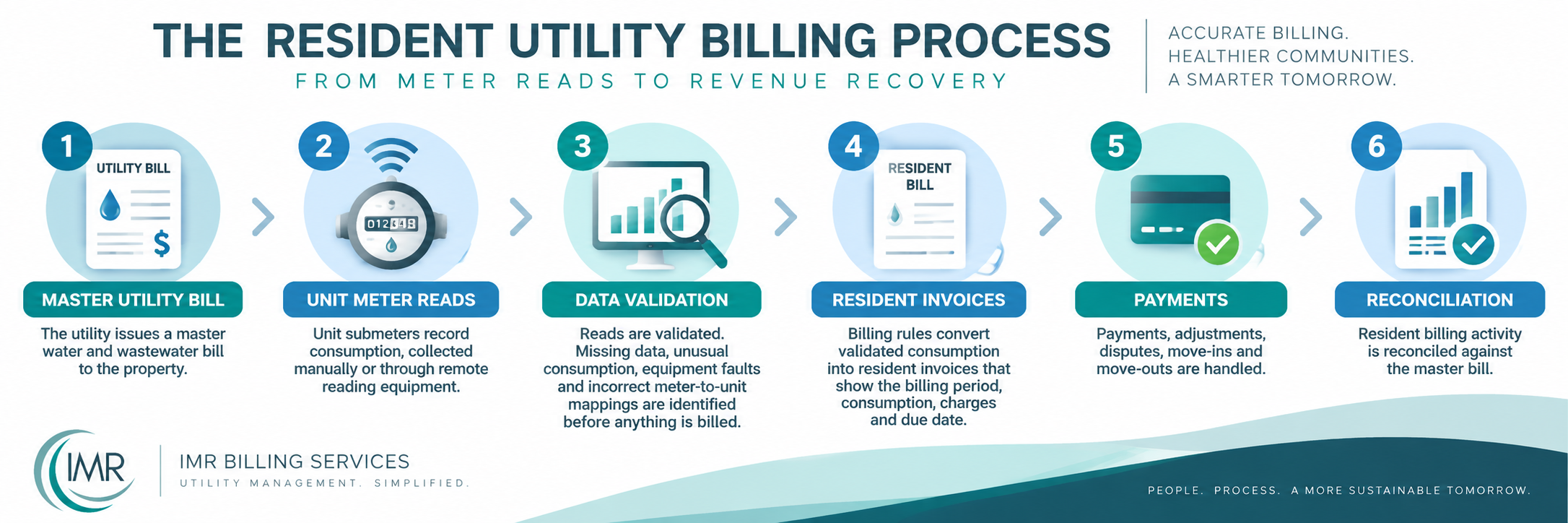
Master utility bill → unit meter reads → data validation → rate configuration → resident invoices → payments → reconciliation
1. The utility issues a master water and wastewater bill to the property.
2. Unit submeters record consumption, collected manually or through remote reading equipment.
3. Reads are validated. Missing data, unusual consumption, equipment faults and incorrect meter-to-unit mappings are identified before anything is billed.
4. Billing rules convert validated consumption into resident invoices that show the billing period, consumption, charges and due date.
5. Payments, adjustments, disputes, move-ins and move-outs are handled.
6. Resident billing activity is reconciled against the master bill.
Resident billing is not invoice generation. It is an ongoing utility-management process that ties together meter data, rates, equipment, residents, payments and property accounting.
Why the Master Bill Rarely Matches the Sum of the Submeters
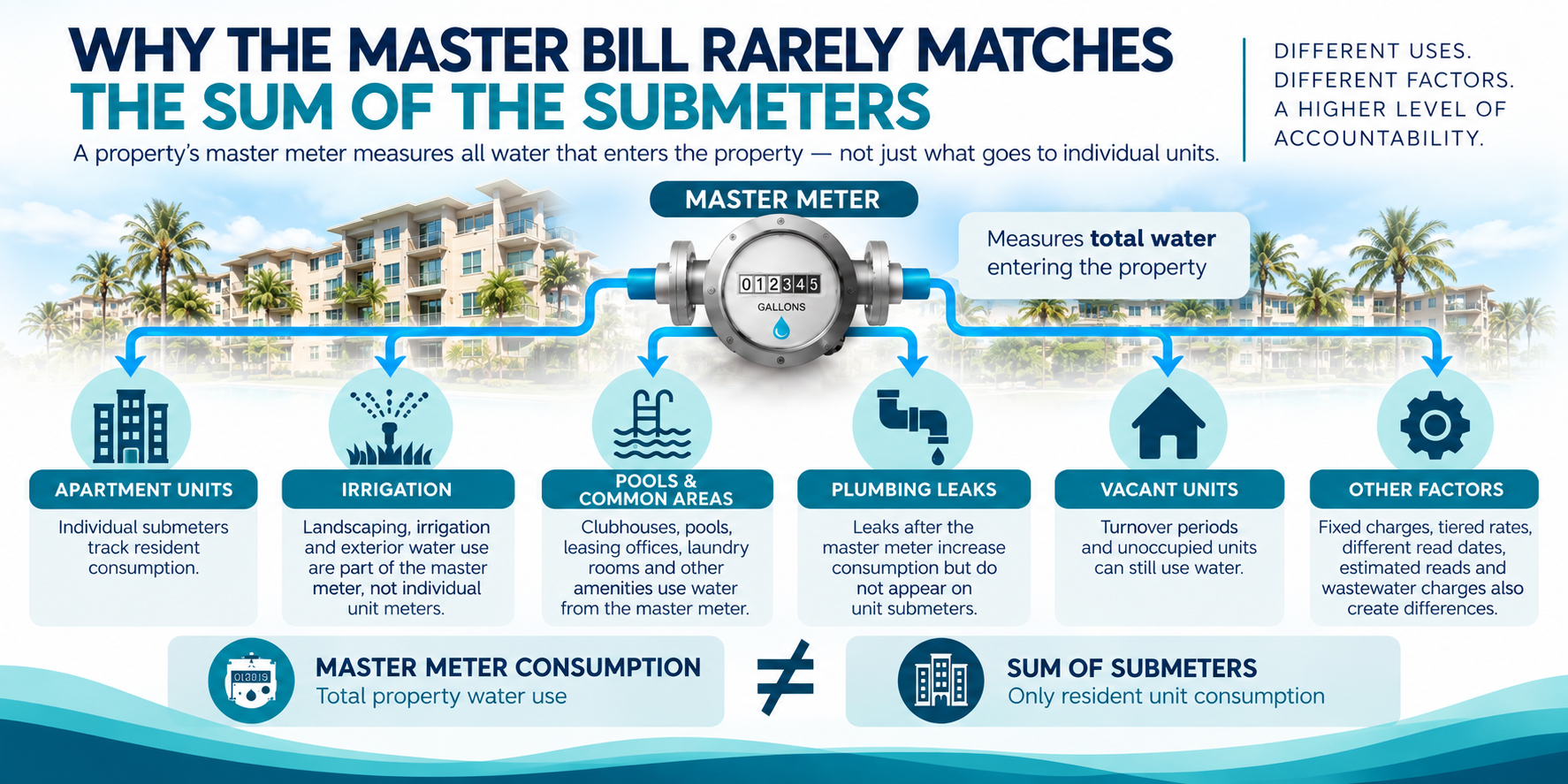
Total unit consumption may not equal the property's master-meter consumption or correspond directly to its total utility expense. Differences can come from:
Irrigation, pools, clubhouses, laundry rooms and other common-area use
Plumbing leaks after the master meter
Vacant units and turnover periods
Fixed charges based on master-meter size rather than usage
Tiered rates driven by aggregate property consumption
Different read dates for the master meter and the submeters
Failed, missing or estimated reads
Wastewater charges calculated from water consumption
Rate changes during the billing period
A large master meter also carries fixed charges that do not fall when residents use less water.
This is why utility billing management has to include reconciliation, not just read collection. The gap between the master bill and resident billing is itself information: it points to where water, or expense, is going.
AMR, AMI and Remote Meter Reading
Most modern submetering systems collect reads without someone walking to every meter.
AMR (Automated Meter Reading) collects meter data remotely, typically through drive-by, walk-by or fixed-network radio.
AMI (Advanced Metering Infrastructure) is a more connected network that can provide frequent reads and, depending on the design, interval data and alerts.
A property system usually looks like this:
Meter → transmitter → repeater → gateway → data platform → billing system
Remote reading does not remove the need for field service or data validation. Transmitters stop communicating. Batteries die. Signals get blocked by building layout. Multipliers get configured incorrectly. A meter can be mapped to the wrong apartment.
Any of those problems flows straight into resident bills unless someone is watching for exceptions and maintaining the link between the physical equipment and the billing data.
What to Do When Meter Data Goes Wrong
Suppose a transmitter stops reporting.
That does not mean the water meter has failed. The cause may be a battery, the signal path, a repeater, a gateway or a configuration setting. The property or its billing provider should have a documented exception process that runs before the read becomes a billing problem:
Missing read: verify the physical meter, transmitter status and meter-to-unit mapping; apply a transparent, documented estimate only where the billing rules allow it.
Meter replacement: record the old and new register readings, the replacement date and the account mapping.
Incorrect multiplier: correct it before it creates material over- or underbilling.
Sudden zero, spike or continuous flow: investigate before billing.
This is the reason field service, meter-data management and utility billing should operate as one function rather than three.
How Submeter Data Can Flag Possible Water Leaks
A master bill tells management how much water the property used. Unit-level data shows where.
Patterns worth investigating include:
Continuous water use with no idle periods
Consumption during overnight hours
A sharp increase from a unit's history
Water use in a vacant apartment
Abnormal irrigation demand
A widening gap between master consumption and known unit and common-area use
These patterns do not prove a leak exists. They identify something that deserves a look. A running toilet flapper can create continuous low-volume use with no visible flooding. A concealed plumbing leak can run for weeks before maintenance sees physical evidence.
Used this way, submeter data becomes an operational signal for maintenance, not just a billing input, and supports multifamily water leak prevention without promising savings the data cannot guarantee.
Florida Utility Billing: What to Verify Before Billing Residents
Resident utility billing in Florida can involve several layers of requirements: state statutes, local utility rules, lease agreements and, where applicable, condominium or HOA governing documents. A municipal utility's policy is not automatically a statewide legal requirement, and a billing vendor's convention is not law.
Before starting or materially changing a resident billing program, verify:
Property type. Multifamily rentals, condominiums, HOAs, mobile home communities and commercial properties do not necessarily operate under identical requirements.
Billing method. Measured submeter billing and formula-based allocation are different approaches and may be treated differently.
Lease or governing documents. Resident responsibility for utility-related charges, and the disclosures required, depend on the applicable agreements.
Utility provider. Rates and account policies vary by service territory.
The charges being billed. Consumption, wastewater, billing-service charges, late fees and convenience fees are not the same kind of charge and should not be treated as if they were.
*Owners should obtain property-specific legal guidance before implementing or changing resident utility charges. This article provides operational information, not legal advice.
A Broward Property Manager's Utility Billing Checklist
Whether you are evaluating a new submetering program or trying to understand why an existing one is underperforming, start here:
Identify the property's actual water and wastewater provider by service address.
Confirm the current rate schedule, effective date and account classification.
Determine whether the property is master-metered, directly metered or submetered.
Verify every meter-to-unit mapping.
Identify common-area, irrigation and other non-unit water use.
Review meter-reading equipment and communication status.
Establish procedures for missing reads, failed devices and abnormal consumption.
Review leases, disclosures and governing documents.
Reconcile resident billing against the master utility bill every cycle.
Investigate unexplained differences instead of assuming they are normal.
The question is not "Do we have submeters?" It is: Do we understand the entire path from the utility's master meter to the resident's bill?
Frequently Asked Questions
-
It depends on the property's service territory. Broward County Water and Wastewater Services and several municipal utilities operate within the county. Verify the provider for the specific address rather than assuming the city name determines the utility.
-
No. Fixed charges, meter-size charges, usage tiers, wastewater calculations and account policies vary by provider and service territory.
-
Water submetering measures consumption for individual units or defined areas downstream from a property's master meter, giving management unit-level data a master meter alone cannot provide.
-
Submetering bills measured consumption for each unit. RUBS allocates utility cost by formula rather than by each unit's measured use.
-
Common-area use, irrigation, leaks, vacant units, fixed charges, read-date timing, rate tiers and missing or inaccurate reads all create differences between master and unit-level totals.
-
It can flag unusual consumption patterns that warrant investigation, such as continuous use, overnight consumption, sudden increases or use in vacant units. Meter data alone does not prove a leak exists.
-
Investigate before assuming the meter has failed. The transmitter, battery, signal path, repeater, gateway or configuration may be responsible. A documented exception and field-service process protects billing accuracy.
-
It depends on the property type, billing method, lease disclosures and applicable law and local rules. Owners should have Florida counsel review the arrangement before implementing charges.
Better Utility Management Starts With Better Information
For Broward County property managers, effective utility billing starts long before a resident invoice is generated. It begins with understanding the utility provider, master bill, submetering infrastructure, rate structure and water-use data. Accurate meter reads, exception management, resident billing, field service and regular reconciliation provide a clearer picture of how water is being used and where utility expense may be going.
f you are not sure whether your property's current setup is capturing consumption accurately and managing exceptions, schedule a utility billing review with IMR Billing Services.