
The Future of Water Billing: How Technology, Conservation, and Rising Water Costs Are Changing Property Management
For decades, water billing at multifamily properties followed a relatively simple process: a meter was read, consumption was calculated, and a bill was produced.
That model is beginning to change.
Across South Florida and the broader water industry, population growth, limited freshwater resources, rising infrastructure costs, conservation efforts, smart metering, and more detailed consumption data are changing what a water meter can do—and what property owners and managers can learn from it.
The result may be a significant shift in the role of utility billing itself.
Instead of water management ending with a monthly bill, the future is increasingly moving toward a connected process in which meters provide frequent data, software identifies unusual consumption, residents and property managers receive alerts, maintenance teams investigate problems, and billing records document what happened.
For multifamily properties, condominiums, HOAs, and other communities, water may increasingly become something that is actively managed rather than simply billed.
South Florida Will Need to Serve More People With Limited Freshwater Resources
The future of water billing begins with the future of water itself.
South Florida is expected to continue growing substantially over the next two decades. The South Florida Water Management District's Lower East Coast planning area—which includes Miami-Dade, Broward, Palm Beach, and surrounding areas—had approximately 6.22 million permanent residents in 2021.
By 2045, that population is projected to reach approximately 7.29 million, an increase of roughly 17%.
Water demand is expected to grow with it. SFWMD projects average total water demand in the Lower East Coast planning area to increase from approximately 1.85 billion gallons per day in 2021 to 2.06 billion gallons per day in 2045. Public water supply is projected to remain the region's largest water-use category.
But South Florida cannot simply assume that traditional freshwater supplies will expand alongside population.
SFWMD describes the Lower East Coast as an area with a growing population and limited freshwater resources. Its long-term planning includes conservation along with alternative water supplies, reclaimed water, storage, and other strategies intended to help meet future demand.
That makes conservation more than an environmental goal.
It increasingly becomes an infrastructure, operational, and economic issue, and multifamily properties are part of that equation.
Official Resource:
South Florida Water Management District — Lower East Coast Water Supply Plan
Rising Water and Sewer Costs Make Every Gallon More Important
Population growth is only one pressure affecting the water industry.
South Florida utilities are simultaneously investing billions of dollars in aging pipes, pump stations, treatment facilities, wastewater systems, capacity expansion, regulatory compliance, and system reliability.
Miami-Dade Water and Sewer Department, for example, has identified a multiyear capital improvement program totaling approximately $8.79 billion to address aging infrastructure, capacity, reliability, pipes, pump stations, and water and wastewater treatment facilities.
Broward and Palm Beach counties are also making significant long-term investments in their water and wastewater systems.
Those investments are necessary, but infrastructure has to be paid for.
Water and sewer rates will not move identically in every municipality or utility territory. However, the underlying pressures—construction costs, treatment, system replacement, regulatory requirements, population growth, energy, labor, and capital investment—are unlikely to disappear.
For property owners, that changes the economics of water loss.
When water and wastewater become more expensive, an unnoticed toilet leak, irrigation failure, broken line, inaccurate meter, or unexplained master-meter variance becomes more expensive as well.
For property management, the question therefore becomes increasingly important:
How much water is the property purchasing—and where is that water actually going?
Official Resource:
Miami-Dade Water and Sewer — Capital Improvement Program
The Water Meter Is Becoming More Than a Billing Device
Traditional water meters were primarily measurement devices. Someone read the meter periodically, the reading was entered into a billing system, and consumption appeared on a monthly statement.
Automated Meter Reading, or AMR, reduced much of the manual work involved in collecting those readings. Advanced Metering Infrastructure, or AMI, takes the concept considerably further.
Networked meters and transmitters can provide much more frequent consumption information. When combined with meter-data platforms and analytics, that information can help identify continuous flow, unusual consumption, communication failures, and other conditions that would have been difficult to see from a single monthly reading.
The U.S. Environmental Protection Agency recognizes advanced metering as an opportunity to improve how water-use information is collected and used. For multifamily properties, individual metering can also give residents greater visibility into their consumption while helping property managers identify problems such as leaks within individual units.
South Florida is already seeing this transition.
The City of Fort Lauderdale is replacing approximately 65,000 water meters as part of its Smart Water Meter Program. The city's AMI system is designed to provide near-real-time water-use information for billing, leak detection, customer access, and notifications about potential leaks or costly issues.
That represents an important change in the purpose of the meter.
The meter is no longer useful only for determining what happened last month. It can increasingly help determine what is happening now.
Official Resources:
U.S. EPA WaterSense — Advanced Metering Infrastructure
City of Fort Lauderdale — Smart Water Meter Program
The Monthly Water Bill May Become the End of the Process, Not the Beginning
This technological change creates an entirely different operating model.
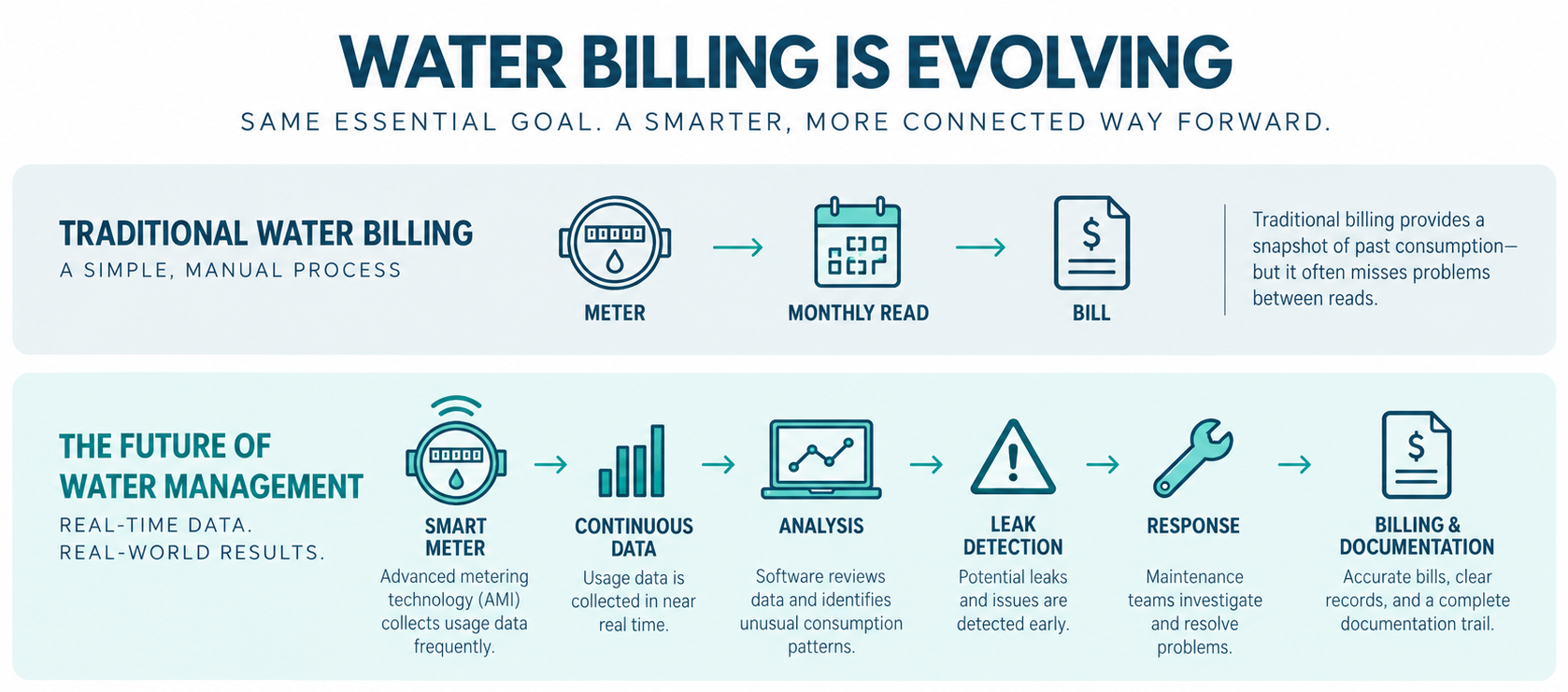
The traditional model looked something like this:
Meter → Monthly Read → Bill
A more connected model can look like this:
Meter → Interval Data → Analysis → Detection → Communication → Maintenance → Resolution → Billing → Documentation
Consider a small continuous leak inside an apartment.
Under a traditional monthly-read system, the leak might continue for days or weeks. Unless the resident sees or hears it, maintenance receives a complaint, or the problem becomes severe enough to cause damage, the first obvious indication may be an unexpectedly high water bill.
Higher-frequency data changes that timeline.
A system can potentially recognize that a unit that normally reaches periods of zero consumption has suddenly been recording continuous flow for many hours.
That does not automatically mean there is a leak, but it creates information that can be investigated. A resident can be contacted. Maintenance can inspect the unit. A toilet flapper, fixture, supply line, irrigation valve, or other problem can be repaired. Subsequent meter data can then help determine whether consumption returned to normal.
The billing record becomes one part of a much larger process.
Leak Detection Could Become a Standard Part of Utility Management
One of the most important opportunities created by higher-frequency water data is earlier leak detection.
Traditional billing systems are very good at calculating consumption after it occurs. They are not necessarily designed to recognize unusual consumption while it is happening.
With more frequent meter data, properties can begin looking for patterns that may deserve attention, including:
continuous low-level water use, unusual overnight consumption, sudden increases in usage, water flowing in vacant units, irrigation abnormalities, and unexplained differences between master-meter and submeter consumption.
But collecting the data is only the first step.
A water-monitoring system also needs to determine which conditions are meaningful, who should be notified, whether the condition continues, what action was taken, and whether consumption returned to normal afterward.
This distinction matters because not every unusual reading represents a leak. A resident may have guests, fill a bathtub, wash several loads of laundry, or simply have an unusual day of water use.
Effective monitoring therefore requires more than a threshold.
It requires understanding patterns over time and turning the right information into action.
As smart metering becomes more common, leak detection may increasingly become less of an optional feature and more of an expected part of modern utility management.
Official Resource:
U.S. EPA WaterSense — Advanced Metering Infrastructure
Smart Water Technology Is Not Automatically Smart Water Management
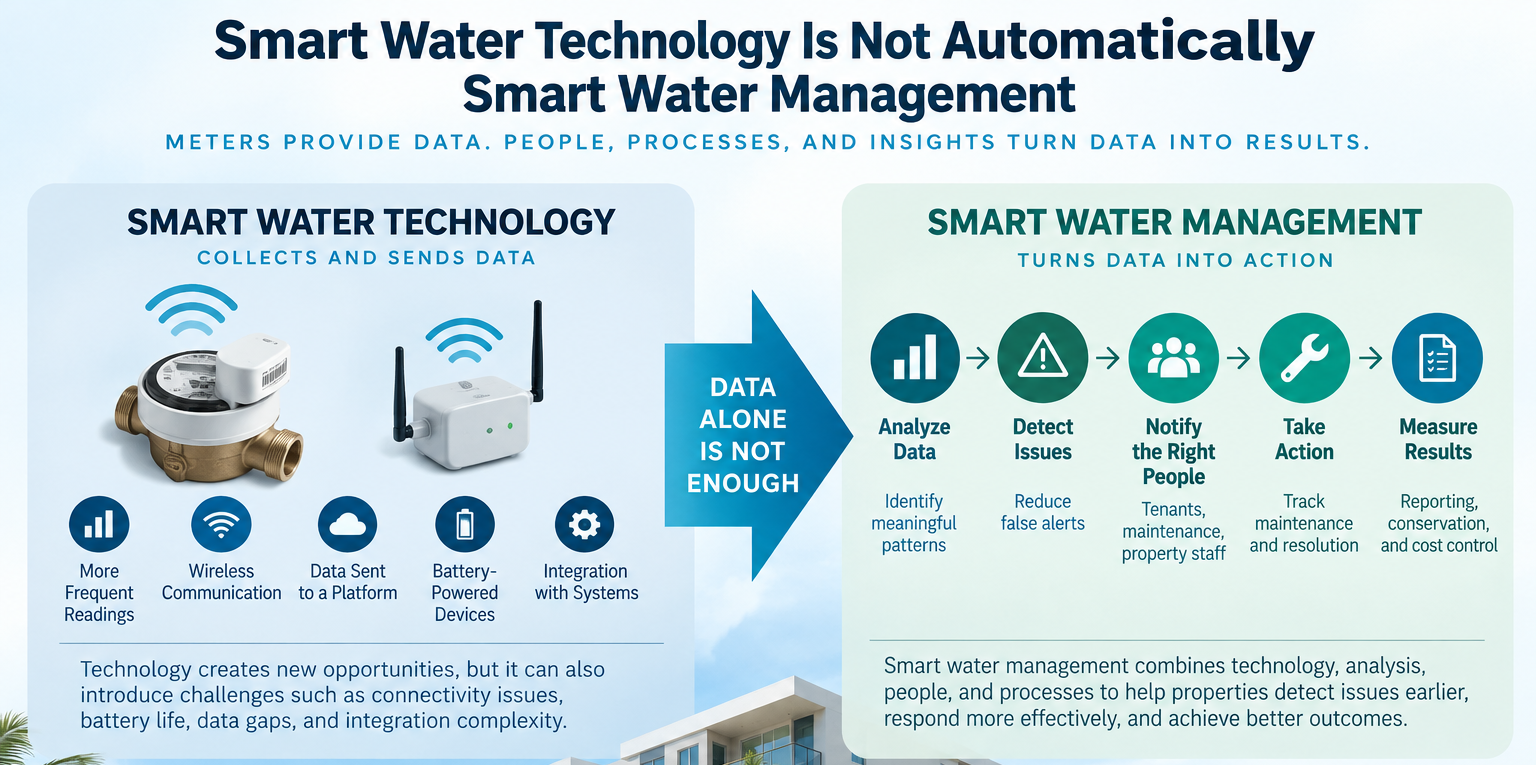
Installing smart meters does not automatically create a smart water-management system.
More frequent data creates new opportunities, but it also creates new challenges. Meter communication can fail. Batteries eventually require replacement. Gateways can lose connectivity. Data can contain gaps or unusual readings. Software platforms may not communicate with existing billing or property-management systems.
And perhaps most importantly, more data can create more alerts.
If every unusual reading generates a notification, property managers and maintenance teams can quickly experience alert fatigue, making it harder to identify the conditions that actually require attention.
This is why the next stage of water technology will likely focus less on simply collecting data and more on interpreting it.
A useful system must be able to distinguish between normal variation and potentially meaningful events, prioritize problems, route information to the right people, and track whether the issue was resolved.
There are also practical considerations involving cybersecurity, resident privacy, system integration, equipment maintenance, and the cost of deploying and supporting connected infrastructure.
Technology alone does not solve those problems.
The challenge is no longer simply collecting more water data. It is determining which data requires action.
Submetering Can Change the Relationship Between Residents and Water
Water consumption is difficult to manage when residents cannot see how much they are using.
Submetering changes that relationship by connecting individual consumption more directly to the resident using the water.
The U.S. Environmental Protection Agency cites research showing that residents in individually metered and billed multifamily units used approximately 15% less water than residents in comparable unmetered units.
That does not mean every property will achieve a 15% reduction. Building characteristics, residents, fixtures, rates, billing structures, and conservation programs all influence consumption.
But the broader principle is important:
Visibility can influence behavior.
As utility technology evolves, residents may increasingly expect more than a monthly balance. Consumption histories, unusual-usage notifications, leak alerts, clearer explanations of charges, and easier access to water-use information could become part of the resident experience.
For property managers, that creates an opportunity to improve both conservation and transparency.
More information, however, must also be understandable.
More data should ultimately produce clearer answers, not more confusion.
Official Resource:
EPA WaterSense — Metering and Submetering
Water Conservation Is Moving Inside the Building
Water conservation is often discussed at the regional level—reservoirs, aquifers, irrigation restrictions, treatment plants, and alternative water supplies.
But for a property manager, conservation often happens much closer to home.
It happens at the toilet that runs continuously, the faucet that never completely closes, the irrigation zone operating incorrectly, the leaking supply line, or the common-area fixture consuming more water than expected.
This is why individual submetering alone does not provide the complete picture of a property's water consumption.
A property may accurately bill residents for individually metered consumption while still losing significant water through irrigation, common areas, equipment problems, leaks, or differences between what the master meter records and what individual submeters capture.
The future of water management will likely require a more complete view of the property: individual unit meters, irrigation and common-area consumption, master-meter reconciliation, meter health, and continuous monitoring working together.
That changes one of the fundamental questions surrounding utility billing.
Instead of asking only:
“Who should pay for this water?” Property managers may increasingly need to ask: “Where did the water go?”
Regulations and Billing Expectations Are Evolving Too
Technology and conservation are changing quickly, but regulation remains an equally important part of utility management.
Florida already has laws governing certain utility-resale and billing arrangements. For example, Florida Statute §367.022 includes provisions allowing certain landlords and property owners to recover the actual cost of purchased utility service from tenants or individually metered residents, along with qualifying meter-reading and billing costs subject to statutory limitations.
South Florida also operates under water-conservation requirements, including year-round landscape irrigation restrictions administered through the South Florida Water Management District and local governments.
These rules matter because the future of water management will not be shaped by technology alone. Conservation policy, utility rates, billing regulations, local ordinances, building requirements, and water-supply planning can all influence how properties measure, manage, and recover water costs.
It is also important to separate current requirements from future possibilities.
At this time, our research did not identify a universal Florida requirement forcing every existing multifamily property to install individual smart water meters, AMI systems, leak-detection technology, or resident water dashboards.
Those technologies may become increasingly common, and regulations may continue to evolve, but property owners should evaluate requirements based on their specific jurisdiction, property type, utility provider, and billing structure.
The direction of the industry may be becoming clearer even when the exact regulatory path is not.
Official Resources:
Florida Legislature — Florida Statute §367.022
South Florida Water Management District — Year-Round Landscape Irrigation Rule
Property Managers May Increasingly Become Water Managers
As water systems become more connected, the role of property management may expand with them.
A modern water-management operation can involve much more than reviewing a monthly utility bill. Property teams may need visibility into meter equipment, missing readings, unusual consumption, resident notifications, maintenance activity, leak resolution, and whether repairs actually returned consumption to normal.
That means information that once existed in separate places can begin to connect.
Water data becomes maintenance data. Maintenance data becomes billing data. Billing data becomes resident-service data. And together, those records create a history of what happened at the property.
Consider a vacant apartment that begins recording continuous water consumption. The meter data identifies the condition. A monitoring system flags it. Property staff receives the information. Maintenance investigates. A leaking toilet is repaired. Subsequent readings verify that consumption returned to normal.
In that scenario, the value isn't simply the meter reading.
The value comes from connecting detection, communication, action, verification, and documentation.
Property managers do not need to become water engineers. But they may increasingly need systems and service providers capable of turning water information into something their teams can actually use.
Artificial Intelligence May Help Determine What Actually Matters
As properties generate more frequent water-consumption data, another challenge emerges: determining which information actually deserves attention.
A large multifamily portfolio can potentially generate thousands or millions of meter readings. Reviewing that information manually would be impractical.
This is where artificial intelligence and machine learning may become increasingly useful. Instead of relying only on a fixed threshold—such as flagging every unit consuming more than a certain number of gallons per hour—analytics can potentially evaluate consumption patterns over time, compare current behavior with historical behavior, identify anomalies, prioritize unusual conditions, and help distinguish persistent problems from temporary changes in usage.
The question begins to change from: “Did this meter exceed a threshold?” to “Is this consumption unusual for this unit, at this time, under these conditions—and does someone need to act?”
That distinction could become increasingly important as connected meters become more common. But AI has limitations too. Artificial intelligence cannot compensate for inaccurate meters, missing telemetry, incorrect property records, poor data quality, or a maintenance process that never responds to an alert.
AI may help identify what matters. People and operational systems still have to do something about it.
Water Monitoring May Also Become a Risk-Management Tool
The financial impact of a water problem does not always stop with the utility bill. A leaking supply line, overflowing fixture, failed appliance connection, or other plumbing problem can potentially lead to damaged flooring, drywall, cabinetry, personal property, mold remediation, resident displacement, and insurance claims.
That makes time-to-detection and time-to-response increasingly important.
The Insurance Information Institute reports that water damage and freezing claims for U.S. homeowners had an average claim severity of approximately $15,400 from 2020 through 2024. That figure should not be interpreted as the average cost of a multifamily water-loss event, but it demonstrates how financially significant water damage can become.
Meter-based monitoring cannot detect every type of water problem, nor can it prevent every loss. But when abnormal consumption is visible earlier, property teams may have an opportunity to investigate before a problem continues unnoticed for days or weeks.
This creates another potential role for water-consumption data. It is not simply billing information. It can also become part of a property's broader risk-management strategy.
Official Resource:
Insurance Information Institute — Facts + Statistics: Homeowners and Renters Insurance
What Could Water Billing Look Like by 2030?
No one can predict exactly how quickly water technology, regulations, or property-management practices will evolve. But the direction of the industry provides some clues.
By 2030, a growing number of multifamily properties may operate with more frequent consumption data, resident usage portals, automated leak and high-usage alerts, vacant-unit monitoring, meter-health monitoring, and stronger connections between utility data and maintenance operations.
Property managers may receive information about unusual consumption before the monthly utility bill arrives. Residents may have greater visibility into their own usage. Maintenance teams may receive prioritized issues rather than discovering problems through complaints alone.
Utility billing providers may evolve as well. The traditional role of reading meters, calculating charges, printing bills, and processing payments will remain important. But billing companies may increasingly be expected to help manage the infrastructure and information surrounding those bills.
That could include meter-data management, equipment monitoring, resident communication, field service, leak detection, analytics, documentation, and integration with property-management systems.
The most valuable utility partner may therefore become the company that can do more than calculate what residents owe.
It may be the company that helps the property understand what its water is doing.
Know Where Your Property's Water Is Going
The future of water billing is not about replacing the fundamentals that property owners and managers already rely on. Accurate meter readings, fair resident billing, dependable equipment, responsive customer service, and effective maintenance will remain essential.
What is changing is how those pieces can work together.
At IMR Billing Services, we believe utility billing should provide more than a monthly statement. It should help property managers understand consumption, identify potential problems earlier, communicate more effectively with residents and maintenance teams, and create a clearer picture of how water is being used across the property.
That is why we are continuing to connect utility billing, submetering, field service, resident support, and intelligent water monitoring into a more complete approach to utility management.
Whether you are evaluating an existing submetering system, investigating unexplained water costs, planning a meter upgrade, or simply looking for better visibility into property consumption, the first step is understanding the system you have today.
The future of water management is already taking shape. The question is whether your property is ready for it.
Serving multifamily properties, condominiums, HOAs, mobile home communities, and commercial properties throughout South Florida.
This article is provided for general informational purposes only and does not constitute legal, regulatory, or professional advice. Utility rates, billing requirements, conservation rules, and regulations may vary by jurisdiction, property type, and utility provider.