
Multifamily Leak Detection: Why Finding a Leak Isn’t Enough
Water meters, submeters and monitoring systems can flag abnormal water use weeks before a utility bill does. But detecting a possible leak and resolving it are two different things, and in multifamily housing much of the water loss can happen in between.
It helps to separate two problems first. Water damage is water where it shouldn’t be: a burst supply line, a failed water heater, a wet ceiling. Moisture sensors and automatic shutoff valves are built for that.
Water loss is different. It is water that keeps moving through the meter when it shouldn’t: a running toilet, a stuck valve, an irrigation fault or malfunctioning equipment. Often nothing is wet and nobody complains.
This article is about water loss.
For owners and property managers, the real objective is to identify abnormal use, decide what deserves attention, get it to someone who can act, fix the cause, and keep watching until the meter shows the problem has actually stopped.
A Leak Alert Is Not a Repair
Interval meter data can show continuous consumption, unusual overnight use, sudden increases, recurring patterns and changes from a property’s own history. But a meter measures consumption. It does not see the plumbing.
Continuous flow might be a running toilet. It might also be irrigation, equipment, a filling system or another legitimate use. The EPA’s WaterSense guide for facility managers notes that continuous use is not always a leak, and facilities with normal continuous use may need customized alert settings to avoid nuisance notifications.
So the useful question is not whether the meter generated an alert.
It is what happened next.
Meter Data → Possible Condition → Prioritization → Responsible Person → Investigation → Repair → Continued Monitoring → Verified Resolution
Water keeps running during every handoff in that chain. An alert can be technically correct and still fail if nobody owns the next step.
WHAT METER DATA CAN — AND CAN’T — TELL YOU
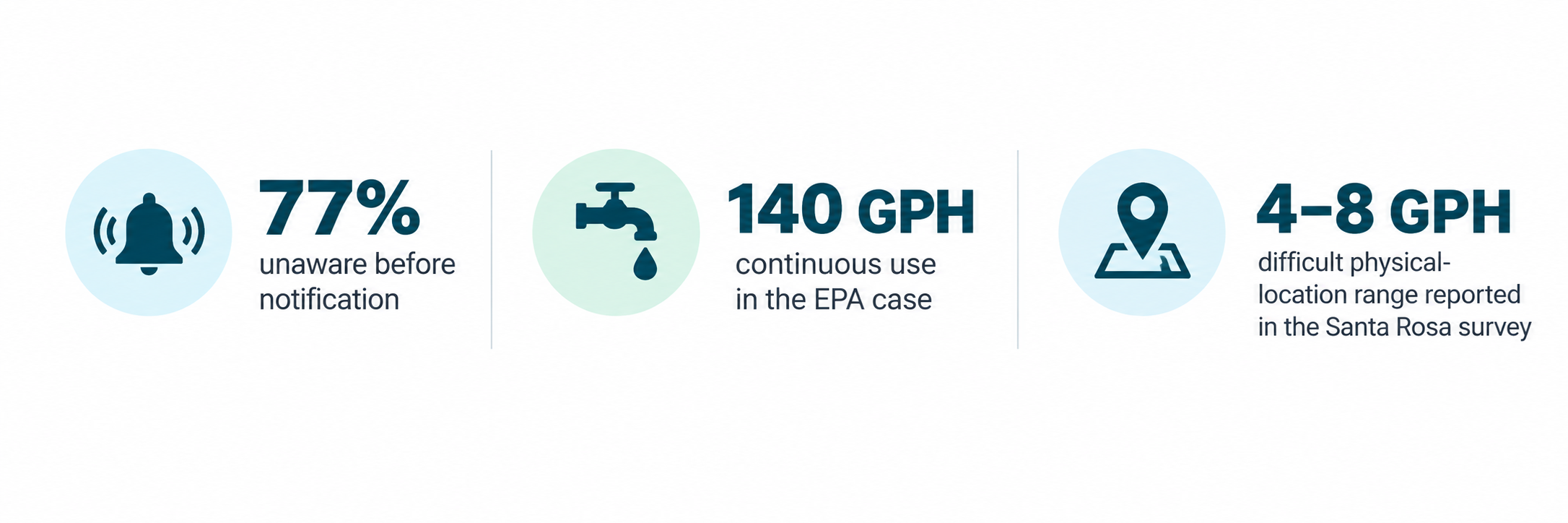
Meter data is valuable because water loss is often invisible. When the San Francisco Public Utilities Commission surveyed single-family and small multifamily customers after leak alerts, 77% said they had not known about the unusual water use until the notice arrived. More than half traced it to a leaking toilet.
With frequent enough readings, a property team can see continuous flow that never returns to zero, elevated overnight use, a jump from baseline, recurring episodes, flow that continues after a reported repair, and a return toward normal afterward.
Read frequency matters. A daily total of 240 gallons could represent a steady 10-gallon-per-hour condition—or simply normal water use spread throughout a busy day. Interval data can reveal whether water use ever returns to zero and when abnormal patterns occur.
Meter data can show that the water-use pattern doesn’t make sense. It usually can’t tell you exactly why.
One EPA case study shows the difference. At Freeman Toyota in Santa Rosa, California, the utility’s portal flagged roughly 140 gallons per hour of continuous use for 48 straight hours. An onsite audit found several leaking toilets—but they were not wasting enough water to explain that volume.
Further investigation eventually isolated a malfunctioning car-wash recirculation system that was running continuously. The toilets were real problems, but they weren’t the whole problem.
Small conditions create another challenge. When the City of Santa Rosa surveyed leak-detection companies about their limits, most reported difficulty locating single-family leaks below roughly 4 to 8 gallons per hour. A low-flow condition can therefore be visible in meter data and still be difficult to locate physically.
MOST LEAKS GET FIXED. THE EXPENSIVE ONES DON’T.
Water loss is not spread evenly across leaks.
The Alliance for Water Efficiency analyzed hourly data from four utilities with proactive leak-notification programs. In Fort Worth’s single-family data, before notifications began, just 2.9% of meters had ten or more leak events—but those meters accounted for 63.8% of all leak volume.
That is single-family data, not a multifamily statistic. But it reveals something important about water loss: a relatively small number of recurring or persistent conditions can drive a disproportionate share of the waste.
The same research found that timing matters. Programs that did not show significant savings relied on slower, manual notification processes, where many leaks may have already ended before the notice arrived. The researchers suggested focusing more attention on larger, unresolved leaks.
WHAT HAPPENS WHEN DETECTION ISN’T ENOUGH?
Research in actual large multifamily properties makes the point even more clearly.
The Pacific Institute deployed 1,198 toilet leak sensors across eight affordable housing properties operated by the Housing Authority of the City of Los Angeles.
Even with leak detection in place, the study found that 51% of toilet water was lost to leaks. The project still reduced overall water use by 11%, but one of its key findings was that sustained, direct engagement with property-management staff was critical to long-term savings.
The technology found the problems. The operational process still had to get them fixed.
For owners and property managers, that changes the question from: “Do we have leak alerts?”
to: “Which conditions are still active, and who is responsible for them?”
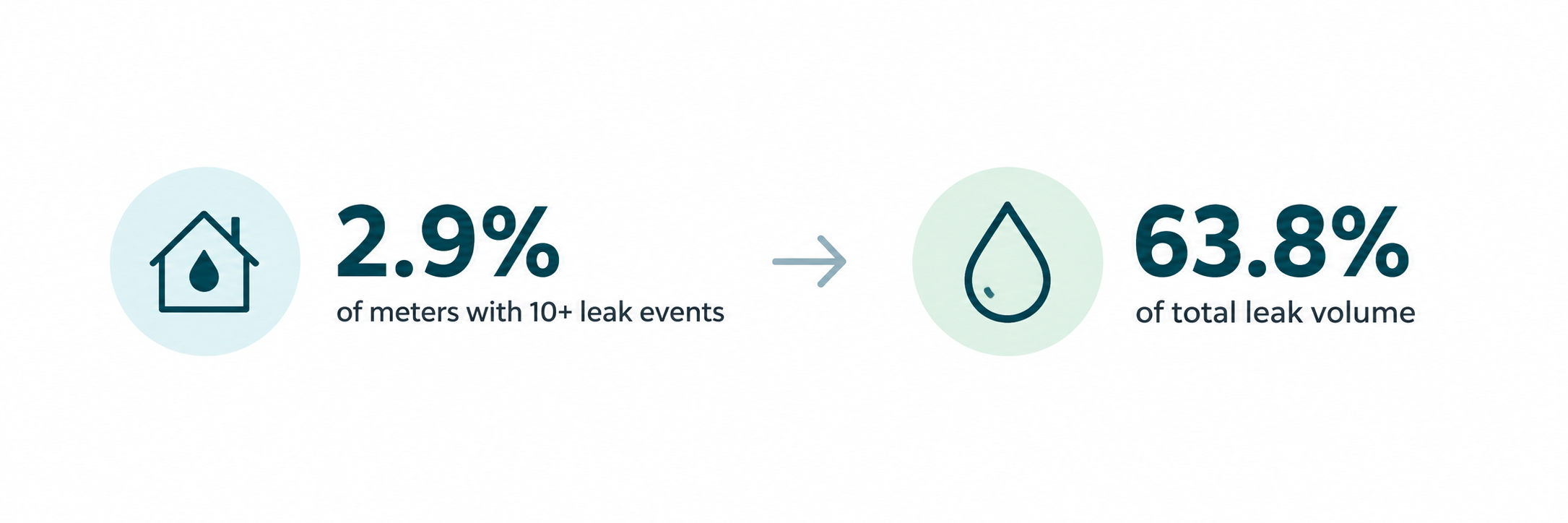
A small share of recurring leak events can account for a disproportionate share of water loss.
Persistent problems can create disproportionate water loss.
Fort Worth single-family data — Alliance for Water Efficiency
WHY MULTIFAMILY MAKES LEAKS LAST LONGER
A homeowner who receives a leak alert can walk into the bathroom and investigate.
A multifamily property is different. There may be hundreds of units, common areas, irrigation systems, mechanical equipment, vacant units, residents, maintenance staff, vendors, property managers and regional managers.
The person who receives the alert is often not the person who can fix the problem.
Resolving a single abnormal water-use condition may require identifying the unit or area, judging its urgency, reaching the right person, arranging access, assigning the work, finding the source, completing the repair—and then checking whether consumption actually changed.
San Francisco’s own leak-notification process illustrates the responsibility problem. Its notice tells tenants they may need to contact the property owner about repairs and asks multifamily recipients to share the notice with other occupants.
AT PORTFOLIO SCALE, LEAK DETECTION BECOMES EXCEPTION MANAGEMENT
An EPA case study involving Albuquerque Public Schools shows what this looks like across a large portfolio.
The Albuquerque Bernalillo County Water Utility Authority conducted more than 100 leak inspections across the school system and identified more than 400 leaks.
Average continuous water use across the school sites began at approximately 300 gallons per hour. By the end of the year, it was below 25 gallons per hour.
But technology was only part of the solution.
The district began tracking leak-related work orders daily, holding regular meetings about persistent problems, and planning additional staff training to improve leak mitigation.
The meters supplied visibility. The organization supplied accountability.
A multifamily portfolio works the same way.
A REPAIR ISN’T FINISHED UNTIL THE DATA SAYS SO
Traditional leak management has another weak point: someone reports the repair complete, and the issue gets closed.
But completing a maintenance task and resolving the underlying water-use condition are not always the same thing.
EPA guidance recommends checking water-use data after a repair to verify that continuous flow is no longer occurring.
A case study at Coddingtown Center in Santa Rosa, California, shows why.
The property manager noticed that the water bill had more than doubled. Meter data confirmed that one meter was running continuously at more than 1,000 gallons per hour.
A leak-detection company located and repaired a mainline break beneath a restaurant.
The water use dropped significantly—but the meter showed that continuous flow was still occurring.
Further investigation found a second mainline break. That was repaired.
Then a third break was discovered and repaired.
The property manager later noted that without the hourly meter data, the team might have assumed the problem was solved after the first repair.
VERIFICATION CHANGES WHAT “COMPLETE” MEANS
Utilities already use this principle. The City of Sacramento, for example, uses its metering system to verify both that a leak exists and that it has been resolved as part of its leak-repair assistance program.
A work order marked complete is not the same as a water-use condition verified resolved.
Meter data provides an independent signal of the outcome:
Did the abnormal flow stop? Did consumption return toward normal? Or is the condition still there?
TIME TO VERIFIED RESOLUTION
Leak-detection systems are usually judged by how quickly they identify abnormal water use. That matters—but property owners ultimately pay for how long the condition continues.
The Alliance for Water Efficiency measures leak duration as the number of hours continuous water use remains at or above a utility’s leak threshold. Leak volume is then determined by the flow rate and how long that condition persists.
For example, a continuous 10-gallon-per-hour condition uses 240 gallons every day. Left unresolved for 30 days, that becomes 7,200 gallons.
For multifamily properties, we think that points to another useful operational metric:
TIME TO VERIFIED RESOLUTION
The time from identifying an abnormal water-use condition until meter data shows that it has stopped or returned toward expected behavior.
It is not currently an industry-standard metric. It is a practical way to measure something that matters: how long abnormal water use remains unresolved.
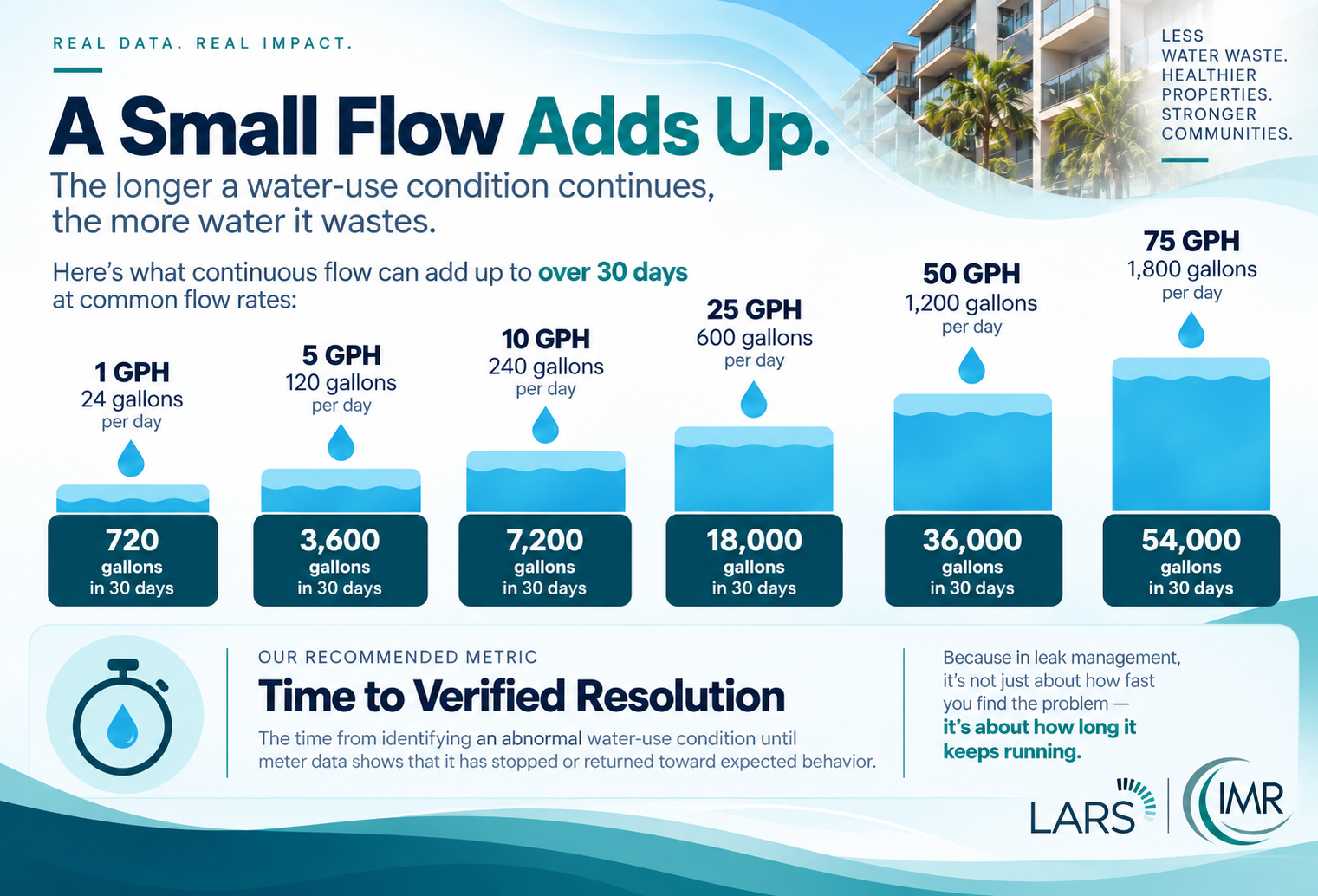
Small continuous water flows can add up quickly. This graphic shows how unresolved flow from 1 to 75 gallons per hour can accumulate over 30 days—and why multifamily leak management should focus on time to verified resolution, not detection alone.
FROM DETECTION TO RESOLUTION
Finding abnormal water use is only the first step. The harder problem is deciding what needs attention, who needs to act, and whether the condition actually gets resolved.
That is the problem IMR Billing Services built the Leak Alert Resolution System (LARS) to work on.
LARS does not assume every abnormal reading is a confirmed leak. It analyzes interval data from compatible meters and submeters and classifies what it sees as a likely leak, a condition to monitor, normal use, or a data anomaly.
Classification considers factors such as flow behavior, duration, persistence, recurrence and severity rather than relying on a single flow threshold.
FROM RAW METER DATA TO ACTION
Detect → Classify → Prioritize → Notify → Monitor → Verify
Alerts are designed to reach the property-management and maintenance contacts responsible for the property, with severity helping determine what deserves attention first.
But sending the notification is not the finish line.
LARS operates around a simple principle:
A condition should stay open while the meter data shows it is still active.
The goal is for closure to depend on positive evidence in the meter data—not simply because an alert was sent, time passed, or a work order was marked complete.
That is where the name comes from:
LEAK ALERT RESOLUTION SYSTEM
The goal isn't more alerts.
It's fewer unresolved conditions.
For multifamily properties already collecting compatible interval meter data, the next step may be to measure more than how quickly a possible leak is detected.
Measure how long it takes to get resolved.
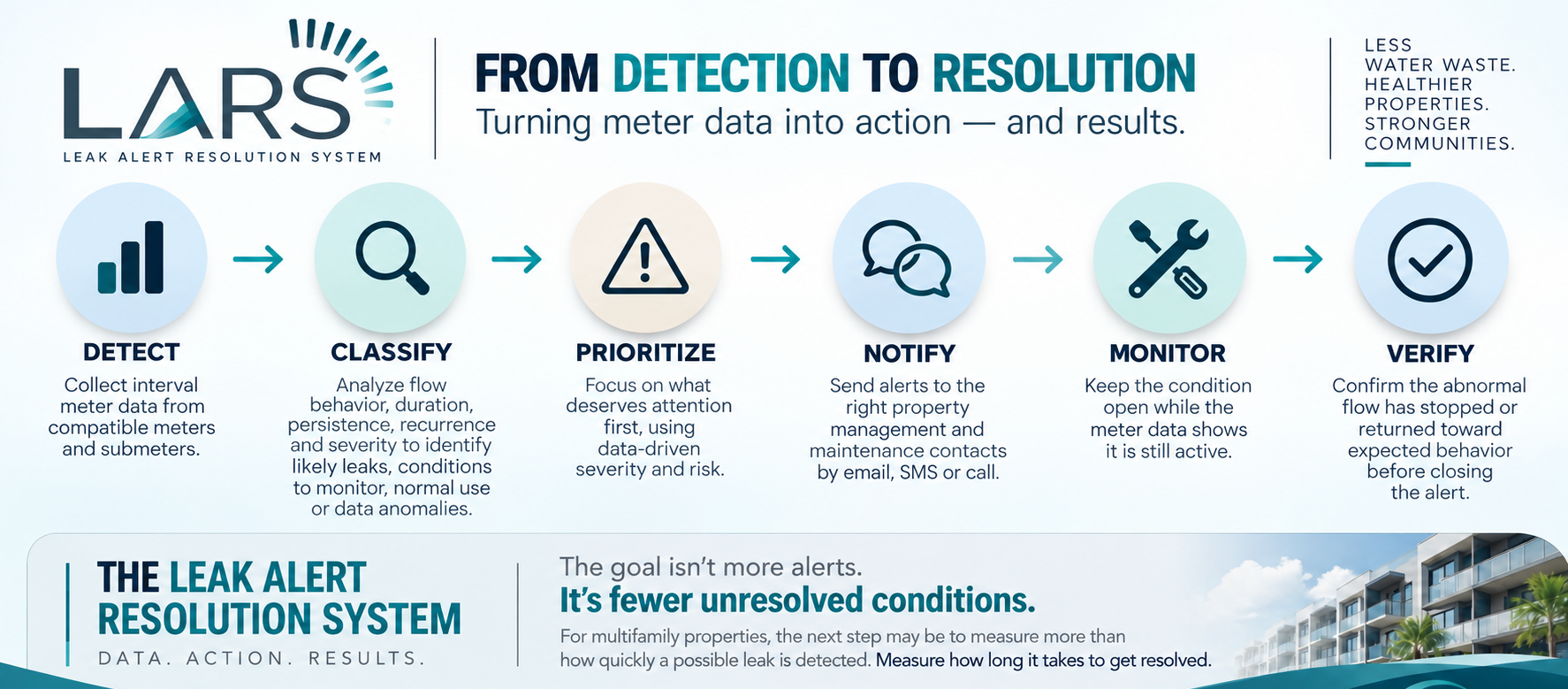
LARS turns multifamily meter data into a structured leak-resolution workflow—detecting abnormal water use, classifying and prioritizing conditions, notifying the appropriate property team, continuing to monitor the meter data, and working toward verified resolution. The goal isn’t more alerts. It’s fewer unresolved conditions.
MULTIFAMILY LEAK DETECTION FAQS
-
No. Continuous water use can indicate a leak, but irrigation, equipment, filling systems and other legitimate uses can create similar patterns. EPA guidance recommends interpreting continuous use in the context of the property rather than assuming every continuous-flow condition is a confirmed leak.
-
Usually not. Meter and submeter data can identify abnormal consumption and, depending on how the property is metered, may narrow the problem to a particular unit or area. Finding the physical source generally requires investigation.
-
Multifamily properties have more than just additional meters and fixtures. Residents, maintenance teams, property managers, vendors and owners may all be involved between detection and repair, and access to individual units may also be required. That makes leak management an operational challenge as well as a technical one.
-
A continuous flow of 10 gallons per hour equals 240 gallons per day, 1,680 gallons per week and 7,200 gallons over 30 days. How much of that represents avoidable water loss depends on what is causing the consumption.
-
Property teams can compare interval meter data before and after the repair. If the abnormal pattern stops or returns toward expected behavior, the data provides independent evidence that the condition was resolved. If abnormal consumption continues, further investigation may be necessary.
-
In some properties, yes. Compatible submeters and AMI?AMR systems can provide interval consumption data that software can analyze for continuous flow, abnormal usage patterns and persistent conditions. Whether an existing system can support leak monitoring depends on the meter technology, reading frequency, data availability and system access.
MOVE FROM LEAK DETECTION TO RESOLUTION
Already collecting interval meter data? See how LARS can help your property team identify, prioritize and monitor abnormal water-use conditions through resolution.
SOURCES & FURTHER READING
U.S. EPA WaterSense — Improving Water Management Using Advanced Metering Infrastructure Data: A Guide for Facility Managers (September 2022)
Alliance for Water Efficiency — Smart Practices to Save Water: An Evaluation of AMI-enabled Proactive Leak Notification Programs (March 2023)
Pacific Institute — Saving Water and Money Through Toilet Leak Detection: A Los Angeles Case Study in Affordable Multifamily Housing (April 2024)