
Continuous Water Flow in Multifamily Properties: What It Means and How to Detect It
Most people picture a leak as a burst pipe, a soaked ceiling or a water bill that doubles overnight. The leaks we see most often in meter data look nothing like that. There's no flood and no spike. The water just never quite stops.
In meter data, that's called continuous water flow: a meter keeps recording use across consecutive readings instead of dropping back to its normal low or zero level. At a multifamily property, it can mean a running toilet, a leaking fixture, a concealed plumbing problem or equipment that's malfunctioning.
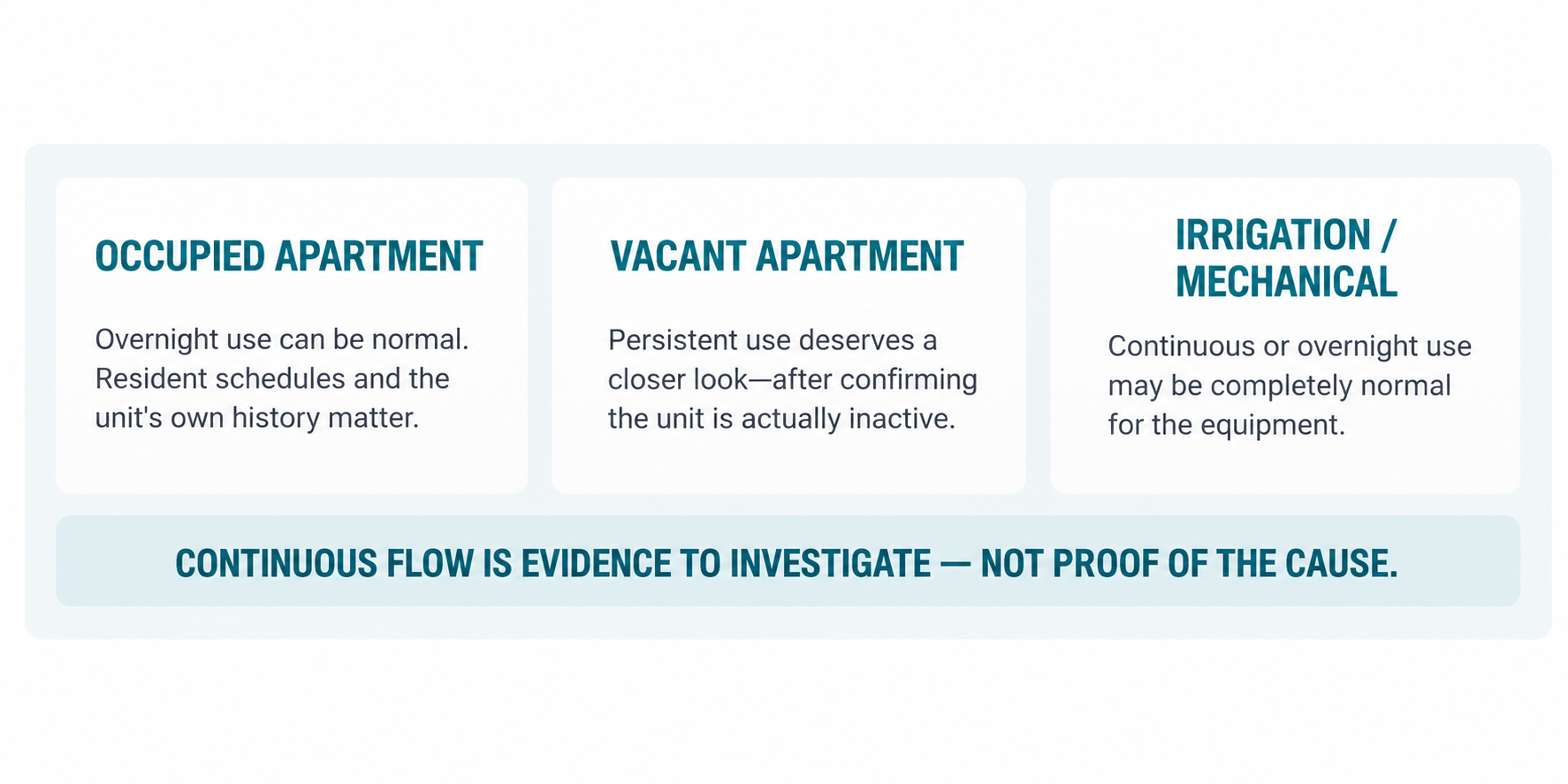
It can also mean nothing is wrong. A busy household, a night-shift worker, an irrigation schedule or a cooling system can all keep water moving for hours.
What Does Continuous Water Flow Mean?
We've spent 17 years working with water submeters, utility billing and meter data. One thing we've learned is that continuous flow isn't defined by one universal number.
Every utility, meter manufacturer and monitoring platform can set its own rule, and the rule depends on how often the meter is read and how alerts are configured.
EPA's WaterSense guidance explains that advanced metering systems can identify continuous-use conditions based on both the amount of water flowing and how long that flow continues. Those settings may be system defaults or configured by the utility. EPA also makes an important distinction: continuous use does not always mean there is a leak.
The definition we use is simpler:
Continuous water flow is a sustained pattern of metered water use that doesn't return to the level normally expected for that unit, meter or asset.
That last part — normally expected for that unit — is important. Two meters can show the same amount of water use and mean completely different things.
WHAT IT LOOKS LIKE IN THE DATA
Normal apartment water use comes in bursts. Someone showers and the water stops. A toilet flushes and the water stops. The washer fills and the water stops. On a chart, that's a series of peaks with gaps between them.
A persistent leak fills in the gaps.
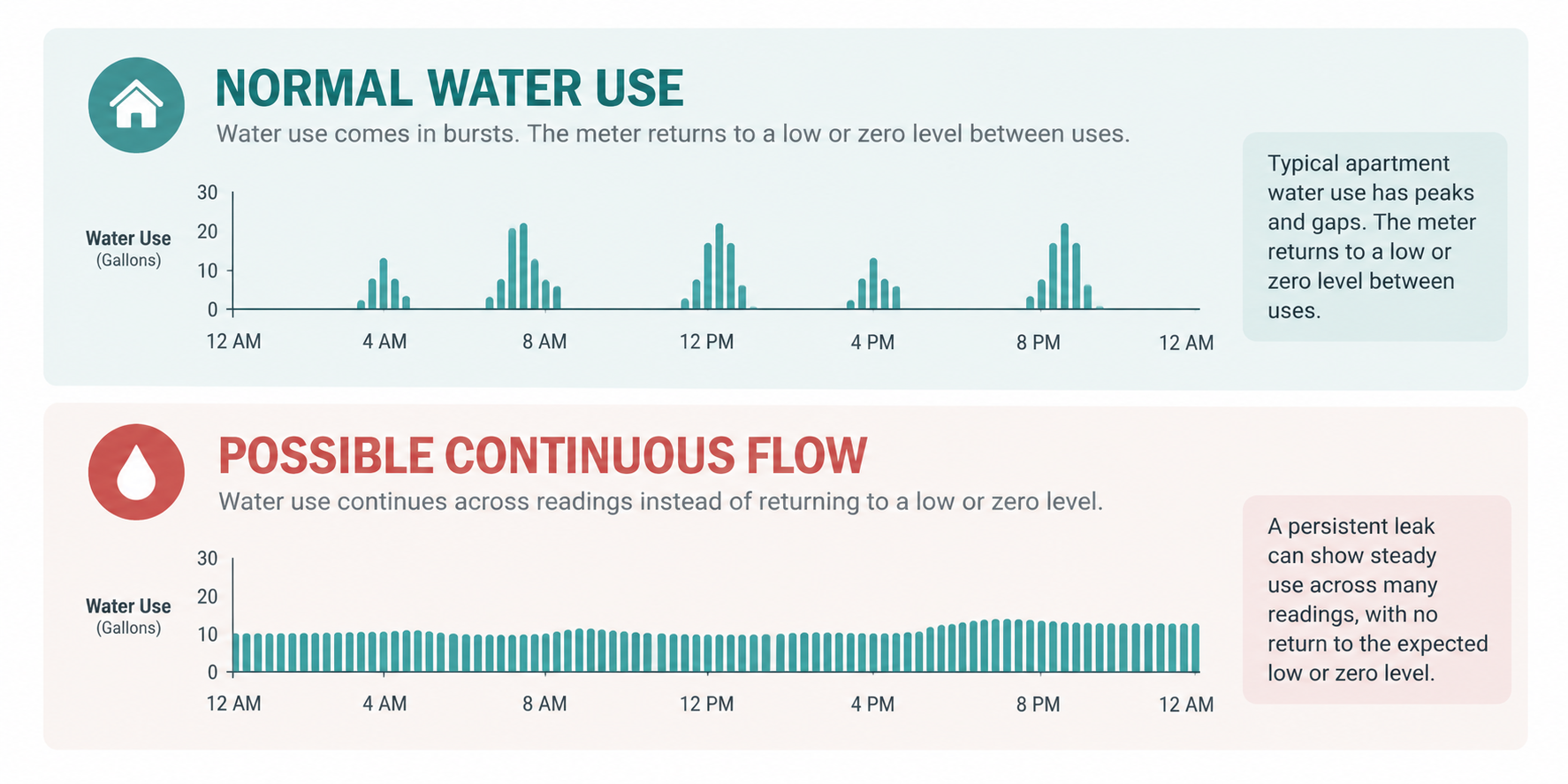
Comparison of normal multifamily water use and possible continuous water flow, showing normal usage with gaps between water-use events and persistent flow that does not return to the expected low or zero level.
That's the textbook version. Real meter data is messier, and two things trip people up more than anything else.
A running toilet doesn't always run continuously. A worn flapper can let the tank drain slowly until the fill valve kicks on, refills it and shuts off again. EPA notes a worn flapper can make a toilet flush on its own or silently leak thousands of gallons a year. On a meter, that can look like short, regular refill cycles with quiet stretches between them. A rule that only asks “did the water ever stop?” can walk right past it.
The meter's resolution can make a steady leak look like on-and-off use. Many meters report in steps, such as one gallon or ten gallons at a time. Say a meter reports in 10-gallon steps and a leak runs at a steady 5 gallons an hour. The hourly readings won't say “5, 5, 5.” They'll say something closer to “10, 0, 10, 0,” because it takes two hours to add up to one reportable step. The leak never paused. The data just can't show anything smaller than 10.
So the question we ask isn't “was water used?” It's “is this pattern normal for this unit?”
HOW WE READ A CONTINUOUS-FLOW PATTERN
Automated rules are a starting point, and we use them. But when our team reviews a flagged meter, we're rarely looking at a single threshold. We're working through the same handful of questions every time:
Is the flow uniform and persistent? The same modest volume hour after hour worries us more than bigger numbers that bounce around. Persistence and consistency count for more than the size of any one reading.
How long did it last? A few consecutive low readings may simply be normal household water use. Several straight hours of similar flow overnight is a different conversation.
When did it happen? Steady flow at 2 p.m. can mean someone's home all day. The same pattern between midnight and 6 a.m. gets a closer look.
Was it one event? A single big reading at 2 a.m. is usually someone using water, not a leak. Heavy flow repeated over several consecutive hours is a flag.
What does this unit normally do? Some residents shower at 3 a.m. before an early shift every day. History tells us whether we're looking at a new pattern or an established habit.
None of these answers the question by itself. Together, they help us decide whether a meter pattern is worth investigating.
DOES CONTINUOUS WATER USAGE ALWAYS MEAN THERE'S A LEAK?
No. And treating every continuous-flow signal as a confirmed leak is how properties end up ignoring their alerts. Send maintenance out for enough false alarms and they stop hurrying.
Legitimate reasons a meter may show sustained or near-continuous use include:
High occupancy or several people using water at once
Night-shift and other nontraditional schedules
Laundry, dishwashing and cleaning
Ice makers and other appliances
Turnover cleaning or maintenance
Irrigation schedules
Pool operations
Cooling or mechanical equipment designed to run for long periods
EPA makes the same point. Its guidance notes that some equipment uses water continuously by design and that metering systems can mistake it for a leak. It also warns that facilities with continuous use as part of normal operations can get false or nuisance notifications, and recommends customizing alert settings for those sites.
Context changes what the same signal means.
COMMON CAUSES IN MULTIFAMILY PROPERTIES
Start with the toilet. EPA lists worn toilet flappers, dripping faucets and other leaking valves among common household leaks, and its dye test is still one of the simplest ways to check. Put a few drops of food coloring in the tank. If color shows up in the bowl within 10 minutes without flushing, the toilet is leaking.
After the toilets, the usual suspects are faucets and shower valves, appliance supply lines, water-heater connections, concealed plumbing leaks, irrigation faults, open hose bibs, pool equipment and mechanical systems.
Each one can leave a different pattern in the data:
Toilet flapper or fill valve: Low steady flow, or short regular refill cycles.
Dripping faucet or shower valve: Low persistent use, sometimes too small for the meter to show clearly.
Concealed plumbing leak: Persistent flow with nothing visible.
Appliance supply-line failure: Sudden jump to high, sustained flow.
Irrigation fault: High flow on a schedule, or flow outside it.
Ice maker, dishwasher or washer: Short cycles with zero-use gaps between them.
A meter won't tell you “the flapper in Unit 304 is leaking.” What it can tell you is that Unit 304 kept using water during hours when its normal pattern says the water should have stopped. That's a claim we can defend, and it gives maintenance a place to start.
CONTINUOUS FLOW VS. A USAGE SPIKE
If there's one idea in this article worth passing along to your team, it's this one.
A usage spike is about size: something used a lot of water in a short time.
Continuous flow is about time: water kept moving.
A broken supply line can produce a sudden, obvious jump. A running toilet can produce a much smaller increase that continues for days or weeks. A high-usage alert is good at catching the first and may miss the second if the flow never crosses the alert threshold.
EPA's guidance treats these as different patterns. Leak notifications may be based on continuous use over a set duration or on a sharp increase in water use.
USAGE SPIKE
Think: SIZE
Large amount of water over a short period.
Common examples: burst line, hose left on, failed valve.
Blind spot: smaller losses that stay below the alert threshold.
CONTINUOUS FLOW
Think: TIME
Water keeps moving over an extended period.
Common examples: running toilet, small concealed leak.
Blind spot: legitimate sustained use can look suspicious.
A property that only asks “did this unit use a lot of water?” can miss the bigger picture. The better question is “did this unit's water-use pattern change?”
WHY SMALL FLOWS ADD UP
Six gallons an hour doesn't sound like much. That's 0.1 gallon a minute. Left running, it comes to 144 gallons a day and 4,320 gallons over 30 days.
That's arithmetic, not a measurement of any specific fixture. But it shows why duration matters so much: a small flow that never stops can waste thousands of gallons without ever producing a spike anyone notices.
6 GALLONS/HOUR → 144 GALLONS/DAY → 4,320 GALLONS/30 DAYS
It's also why the monthly bill is a poor leak detector. The bill tells you how much water was used. Interval data tells you when: whether use ever returned to zero, when the problem started, and whether it stopped after someone responded.
HOW SMART METERS AND SUBMETERS CAN CATCH CONTINUOUS FLOW
A traditional monthly meter read gives you one number. You know how much water was used, but almost nothing about how it was used.
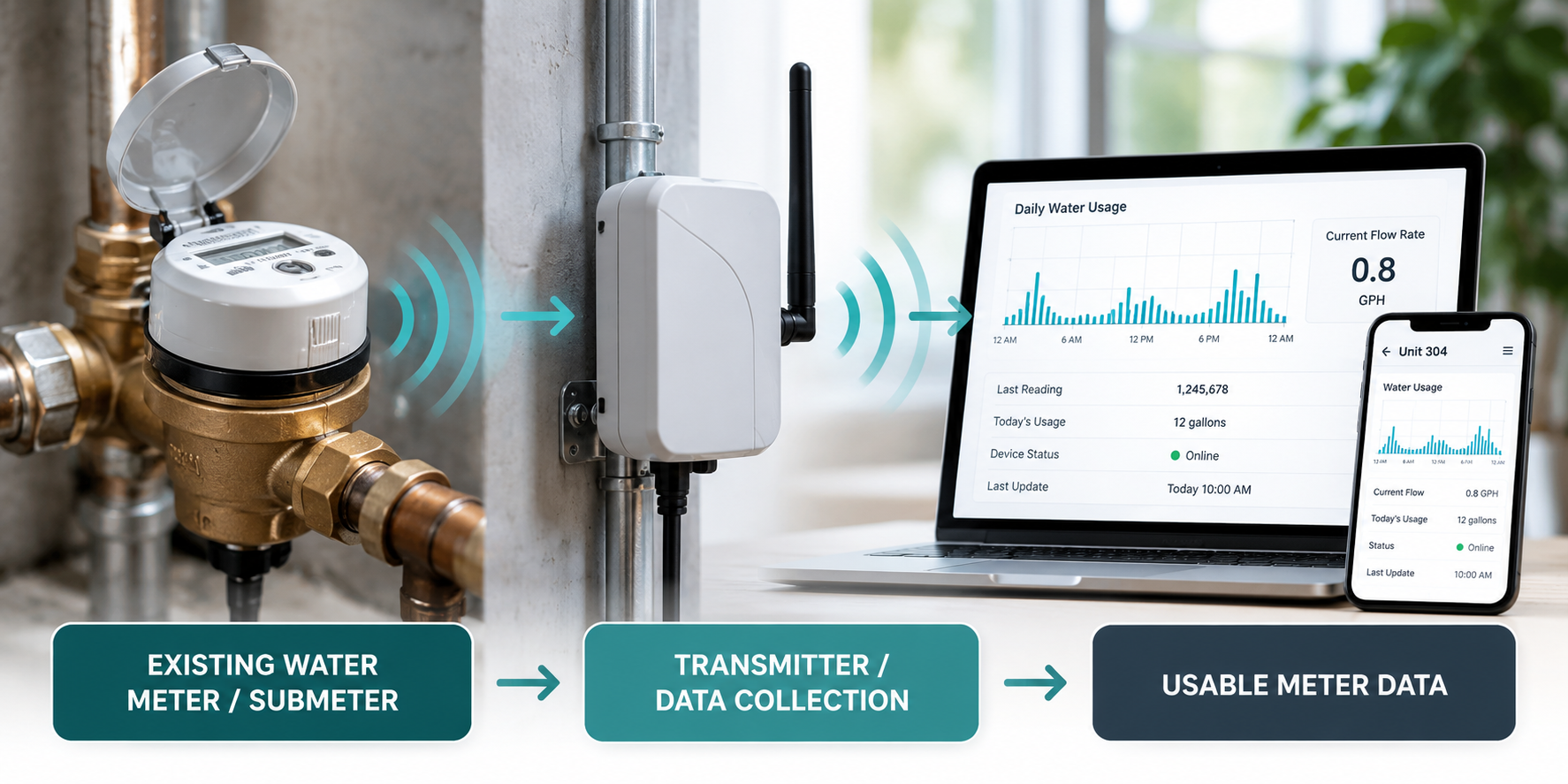
A meter system that records readings throughout the day can tell a much richer story. Depending on the equipment and platform, that data may include timestamps, interval consumption, pulse counts, flow rates, device status and historical readings.
That makes it possible to look for patterns such as:
Persistent non-zero use
Repeated overnight flow
A change from the unit's normal baseline
A sudden increase in consumption
Unusually long periods of use
Water use in a unit believed to be vacant
But the word “smart” doesn't guarantee any of this. What matters is the actual data the system produces.
For leak detection, the useful questions are: How often is the meter read? How small a flow can it register? How quickly is the data available? And can the property access that data reliably?
CAN YOUR EXISTING SUBMETERS DETECT LEAKS?
Potentially, yes. But not every submetering system provides the data needed to do it well.
If a property already has water submeters, transmitters and a remote-reading platform, that infrastructure may already be collecting useful information. The question is whether the system provides readings that are frequent, detailed and accessible enough to identify abnormal water-use patterns.
A system is more useful for leak detection when it provides:
Frequent interval readings
Enough resolution to register small flows
Reliable timestamps
Timely data delivery
Historical readings for comparison
Accurate unit-to-meter mapping
Reliable device-status information
Access to the underlying meter data
A meter that's read only once a month can work perfectly well for billing and still be nearly useless for identifying a leak that ran continuously for three days and stopped before the next read.
This is why adding leak detection doesn't always mean adding more hardware. In some properties, the opportunity is already sitting in the meter data they're collecting.
MULTIFAMILY PROPERTIES HAVE A DIFFERENT LEAK-DETECTION PROBLEM
Finding an unusual meter pattern is one thing. Managing it across a multifamily property is another.
A property may have hundreds of apartments, different resident schedules, vacant units, common-area meters, irrigation, pools and mechanical equipment — all producing water data at the same time. The challenge isn't simply generating more alerts. It's deciding which conditions actually deserve attention.
That means a useful leak-detection process has to consider more than gallons used. It needs context: how long the condition has lasted, when it occurs, whether the pattern is new, how it compares with that unit's history and whether the unit is supposed to be occupied.
The goal isn't to alert on every unusual reading. It's to identify the conditions worth investigating before they become larger water-loss problems.
FINDING THE LEAK IS ONLY THE BEGINNING
An alert doesn't save water. A resolved leak does.
Once a potential problem is identified, someone still has to verify it, prioritize it, notify the right person, investigate the cause and make the repair. Then there's one final question that often gets missed:
Did the water actually stop?
Meter data can help answer that. If a toilet is repaired Tuesday afternoon, the readings afterward should show whether the abnormal pattern disappeared. If it didn't, the property knows the problem isn't resolved yet.
That's the difference between detecting a suspicious pattern and managing it through resolution.
WHY THIS MATTERS IN SOUTH FLORIDA
Water loss matters everywhere, but South Florida properties have added reasons to pay attention. The South Florida Water Management District encourages multifamily communities to regularly check irrigation systems, outdoor faucets, pools and pipes for leaks. For commercial facilities, it also recommends leak-detection programs and submeters or flowmeters for monitoring specific water uses.
Local water rates add another consideration. Utilities such as Miami-Dade use different customer classes and rate structures, so the financial impact of wasted water varies by property. But the operating principle doesn't change: water that runs unnoticed is water the property can't manage.
For properties already collecting meter data, finding abnormal patterns earlier creates an opportunity to investigate before that water loss continues into another billing cycle.
TURNING METER DATA INTO ACTIONABLE LEAK DETECTION
The meter data we've been describing is the same kind of information we work with every day at IMR.
We built LARS — the Leak Alert Resolution System — to analyze compatible existing meter data for patterns that deserve attention. Instead of relying on one high-usage threshold, LARS looks at factors such as persistence, duration, timing, changes from prior consumption and the severity of the condition.
It then turns those patterns into information a property team can investigate and act on.
For properties with compatible submeters and remote-reading infrastructure already in place, that can mean adding another layer of water-loss monitoring without installing a separate leak-detection device in every apartment.
That's the larger opportunity in meter data. The same infrastructure used to measure consumption for billing may also help a property recognize when water use stops behaving normally.
ALREADY HAVE WATER SUBMETERS? YOUR DATA MAY BE ABLE TO DO MORE.
If your property already has water submeters or remote meter-reading equipment, IMR can evaluate whether the existing system can support more proactive water-loss monitoring.
Learn how LARS works and how compatible meter data can be used to identify potential water-loss conditions earlier.
FREQUENTLY ASKED QUESTIONS ABOUT CONTINUOUS WATER FLOW
-
Continuous water flow means a meter continues recording water use across consecutive readings instead of returning to the low or zero level normally expected for that unit or asset. The exact definition depends on the meter system, reading frequency and monitoring rules.
-
No. Continuous flow can result from legitimate water use, including resident schedules, irrigation, pools, cleaning or mechanical equipment. It is a signal worth evaluating, not proof that a leak exists.
-
Potentially. A running toilet may create persistent low flow or repeated refill cycles that appear in sufficiently detailed meter data. Whether the pattern is visible depends on the meter's resolution and how frequently readings are collected.
-
A high-usage alert usually looks for a large amount of water over a short period. A slow leak may never cross that threshold. Continuous-use rules and comparisons with a unit's normal baseline can identify patterns that high-usage thresholds may miss.
-
A usage spike is primarily about volume — a large amount of water used over a short period. Continuous flow is primarily about duration — water continuing to move over time.
-
Potentially. Existing submeters may provide useful leak-detection data when they offer sufficiently frequent readings, adequate low-flow resolution, reliable timestamps and accessible historical data. Not every submetering system provides that level of information.
-
Water use in a confirmed vacant apartment deserves investigation, but it does not automatically prove there is a leak. Cleaning, maintenance, incorrect occupancy information or meter-mapping issues should also be ruled out.
-
Verify the condition, determine its priority, investigate the likely source and make the necessary repair. Then review subsequent meter data when available to determine whether the abnormal water-use pattern stopped.