
How Multifamily Utility Billing Works: From Water Meter to Resident Bill
A resident opens a water bill and sees a charge. The property manager sees a number that has to be correct, explainable and tied to the right apartment.
Multifamily water billing connects measured or allocated water use to resident charges. At a submetered property, that means collecting meter readings, checking the data, calculating consumption, applying the property's billing rules and issuing charges to the correct residents. Payments and property reporting then show what was billed and what was actually recovered.
The equipment matters. So do the decisions made after its readings arrive. A working meter cannot prevent a wrong apartment assignment, an outdated rate or a missed move-out.
Here is how the process works, and where owners and managers should expect their utility billing team to take responsibility.
The master meter and unit submeters answer different questions
The utility's master meter measures all the water delivered through the property's connection. Unit submeters measure the water passing through their own supply lines. They cover different parts of the system.
At a typical master-metered apartment property, the owner receives the utility bill. The submeters downstream provide the unit-level measurements used for consumption-based resident billing.
Water used by landscaping, a pool or shared facilities can pass through the master meter without ever passing through an apartment submeter. Some properties meter those uses separately. Others have to account for them another way.
That is why adding up every resident's usage does not automatically explain the property's total water use.
First, confirm what each unit meter actually measures
A submeter measures only the water routed through it. Capturing an apartment's total use means covering every water supply into that unit. Buildings with shared risers, multiple supply lines or central hot water can need more than one meter per apartment, or a different approach altogether.
For a property considering installation or a retrofit, this is the practical first step: confirm the piping and what each meter will cover before selecting equipment or promising consumption-based billing.
How a water reading gets from the meter to the billing team
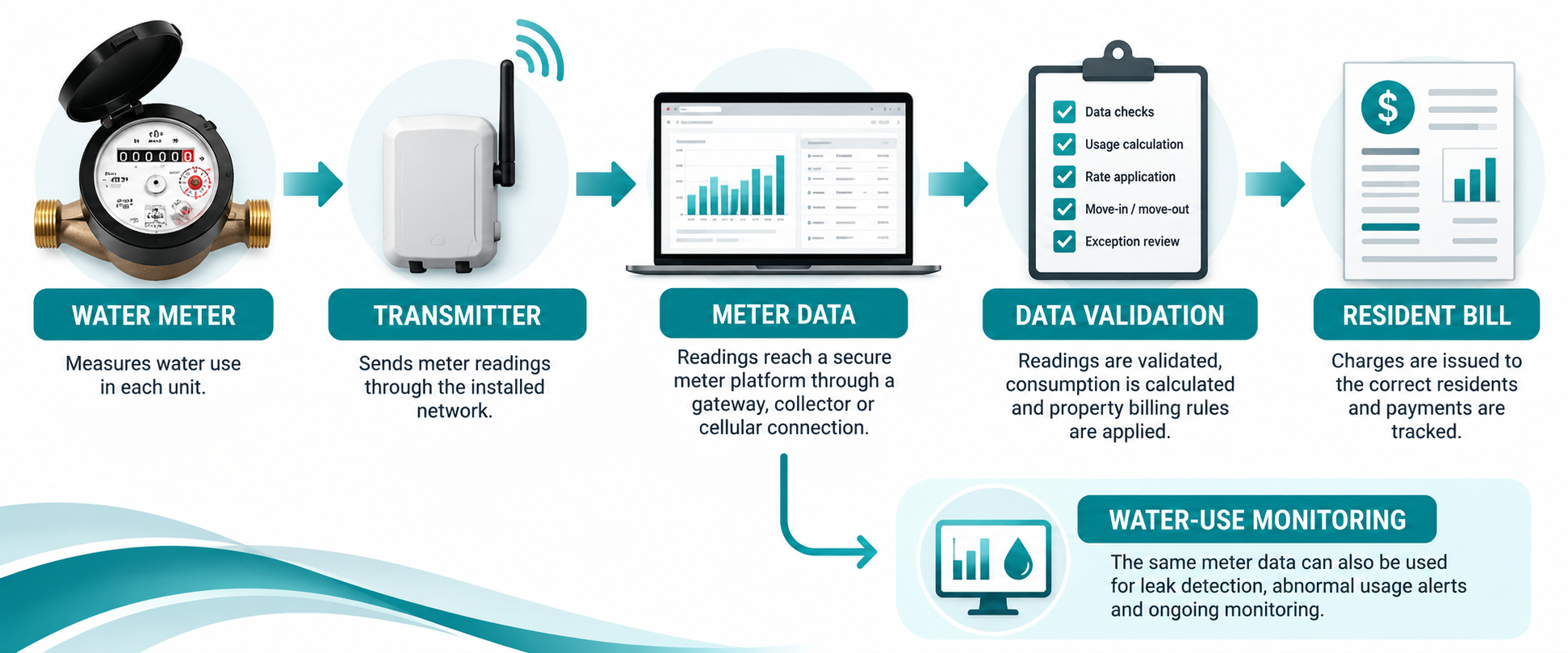
In an automated submetering system, a transmitter attached to the meter sends its readings through the installed network. Depending on the system, that involves a gateway, a collector or a cellular connection before the data reaches a meter platform.
The billing team then reaches the readings through an integration, an export or a platform account. The exact route depends on the equipment and the permissions in place.
You will hear two terms. AMR, automatic meter reading, commonly means collecting readings along a walking or driving route. AMI, advanced metering infrastructure, generally means a fixed communications network that delivers readings automatically. Neither label tells you how often your property's data actually arrives.
Two questions are more useful:
How often does the equipment record water use?
How soon are those readings available to the billing or monitoring team?
Recording hourly readings and delivering them hourly are different capabilities. Confirm both before relying on a system for prompt alerts.
A meter reading is not yet a resident bill
A meter reading is usually a running total. Consumption is the difference between two readings that cover a defined period.
If a gallon-based meter reads 125,000 at the start of the period and 128,200 at the end, the recorded consumption is 3,200 gallons.
That calculation assumes both readings belong to the same meter, use the same scale and cover the intended dates. Some systems need a multiplier or a unit conversion first.
Before consumption becomes a charge, the billing team should check for exceptions.
What should be checked before a resident is billed?
No new reading — Check the last successful read, communication status and whether the meter itself is still registering.
Large change in consumption — Check the dates, configuration, occupancy and whether the change reflects actual use.
Zero usage in an occupied apartment — Check resident records, unit mapping and whether the meter is measuring and reporting.
Ending reading lower than the starting reading — Check replacement history, register rollover or a configuration issue.
Reading filed under the wrong apartment — Verify the meter serial number, transmitter ID and unit mapping.
Estimate standing in for a read — Document the basis for the estimate and true-up once an actual read arrives.
These are operational checks, not automatic diagnoses. A high reading can be real consumption. A missed transmission can happen while the meter keeps registering water.
A meter read is not a bill. Before charging a resident, confirm the reading, the apartment, the billing period and the calculation. When information is missing, keep the estimate and its basis visible. Do not let it pass as an actual read.
The question to put to any billing provider is simple: what happens to an exception after the system flags it?
Turning validated consumption into a resident charge
Once consumption is established, the billing operation applies the property's water and sewer calculations, resident information and billing dates.
Sewer is usually calculated from the same metered water use, so an error in a water reading carries into both charges. Tiered utility rates, fixed components and local restrictions make the work more involved than multiplying gallons by one price. Every charge on the statement needs a documented basis.
A move-in or move-out adds another check: the resident's responsibility period has to match the charge. Otherwise an accurate meter total still produces the wrong bill.
Not every apartment water bill is based on a unit submeter. The main distinction is whether the property measures individual use or allocates cost.
Three common billing approaches
Submetered billing — Water measured through the unit's meter or meters.
RUBS / allocation billing — A formula that divides property costs, often by occupancy, unit size or similar factors.
Fixed charge or water included in rent — A stated charge, or a cost built into rent, unrelated to that month's use in the unit.
RUBS allocates master-meter costs; it does not measure what an apartment actually used. Whichever method a property uses, the charges have to fit the applicable requirements and the resident agreements.
South Florida billing requires a property-specific review
No single billing-fee policy works across every South Florida property.
Florida Statutes section 367.022 lists exemptions from state water-utility regulation. One covers reselling water at the actual purchase price. Another covers the purchase price plus the actual cost of meter reading and billing, up to a 9% limit. That is a condition for an exemption. It is not automatic permission to add a 9% fee to every resident bill.
Local rules can be stricter. Miami-Dade's remetering ordinance puts registration on the property owner, limits what residents can be charged to what the owner pays for the water, sets bill and record requirements, and keeps common-area water off resident bills.
Broward properties need their own check, city by city. Margate's published remetering agreement, for example, includes registration and reporting terms and limits charges to the direct cost of a unit's consumption.
Before starting or changing resident billing, confirm the serving utility, the local requirements, the billing method, the lease language and the charge calculations for that property. A template copied from another community is not enough.
Sending bills and recovering costs are different outcomes
The owner pays a utility invoice. Residents receive charges. Payments arrive afterward. Those are three different records, and a useful property report keeps them apart:
Utility expense — What the property owes its water and sewer supplier.
Resident charges — What was billed for the matching service period.
Resident collections — What has been paid against those charges.
An unpaid bill is a collection problem. A unit that was never billed is a billing problem. Shared water use is a measurement and allocation question. Each needs a different response, and a single "recovery" percentage hides which one you have.
Keeping them apart also keeps expectations realistic. The goal is to recover appropriate, permitted costs accurately. It is not to assume every dollar on the master utility invoice can be passed to residents.
Why the master water bill may not match resident usage
Water reconciliation compares the water the property bought with its unit measurements and its other known uses over the same period.
Start by lining up the dates and the units of measure. A master bill covering one period set against resident readings covering another creates an apparent gap before any water has been lost.
Then ask which uses sit outside the apartment submeters, and whether the reads are complete.
Illustrative water reconciliation
Master-meter consumption: 1,000,000 gallons
Unit-submeter consumption: 820,000 gallons
Separately metered common use: 100,000 gallons
Remaining difference to investigate: 80,000 gallons
This assumes matching dates, matching units and meters that do not overlap. The remainder could be unmetered uses, incomplete reads, measurement differences or water loss. It is not automatically 80,000 gallons of leakage.
The example shows a method, not an industry benchmark. Interpreting the difference takes the property's own meter layout, operating history and records.
Location matters too. A leak inside an apartment may already show up in that unit's consumption. A leak upstream of the apartment meters shows up in the master reading and nowhere in the resident totals.
The numbers point to the next check. Someone still has to go and complete it, which is where coordinated meter, field and billing support earns its keep.
The same meter data can help between billing cycles
A monthly total tells you how much water was recorded. Interval data tells you when.
With suitable data, a property can look for sustained use that never drops to zero, sudden changes, or consumption that does not fit a unit's known occupancy. What those patterns mean depends on what the meter covers, how fine the data is and how the property operates.
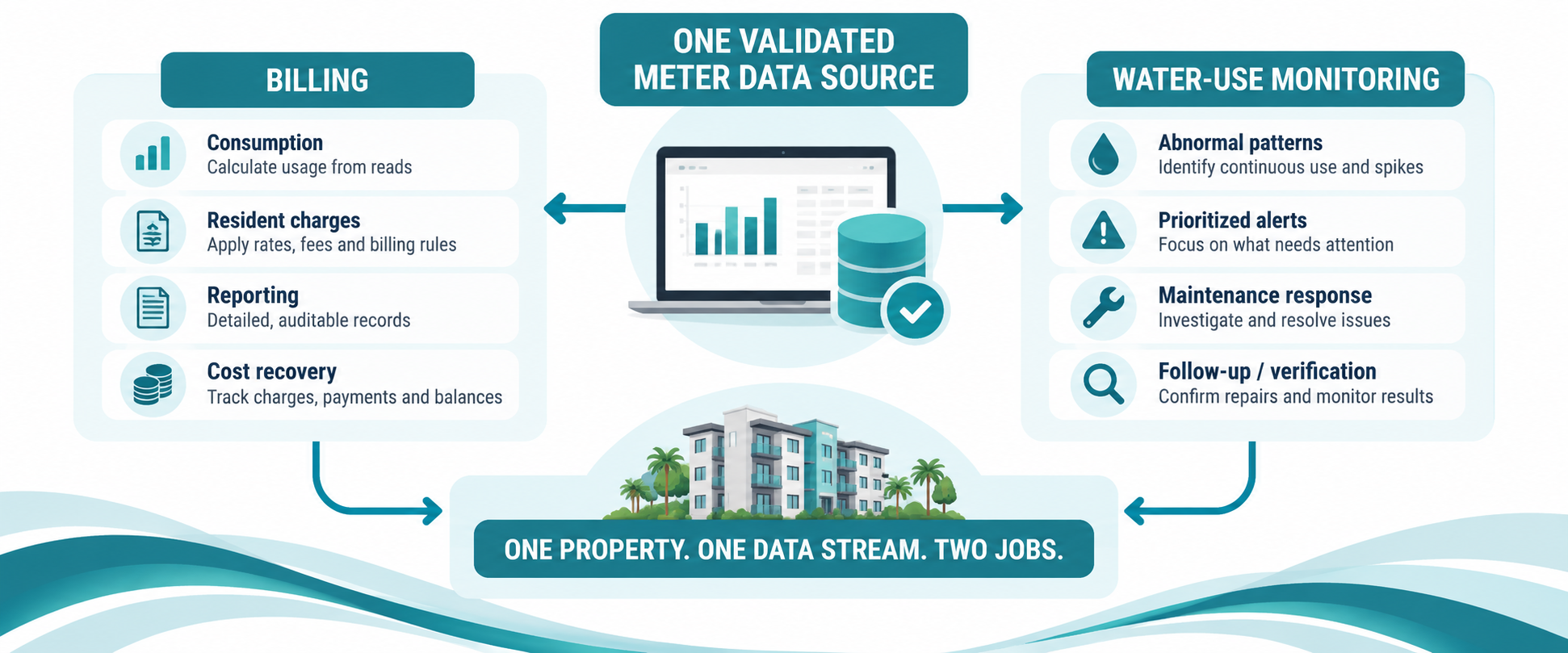
Billing and monitoring answer different questions
Billing asks: How much water should be charged for this period?
Monitoring asks: Does this usage pattern need attention before the next bill?
The two run in parallel from the same validated data. Monitoring does not wait for a resident statement.
Frequent meter data can support the investigation of unusual use and follow-up after repairs. Continuous use can also have legitimate causes, so a flagged pattern gives maintenance a reason to inspect. On its own, it does not prove which fixture or pipe is responsible.
One local point is worth knowing. Palm Beach County Water Utilities says customers served through a master meter cannot receive individual-unit alerts from its myAMI portal. Visibility into the utility's master meter and visibility into each apartment are different things.
Where LARS fits
IMR's LARS, the Leak Alert Resolution System, uses compatible existing meter data to identify abnormal water-use patterns and help property teams decide what to look at first.
Where the equipment and authorized data access support it, monitoring runs on the submeter infrastructure the property already has, without a separate leak sensor in every apartment. Compatibility has to be confirmed first.
The work is to identify a concern, notify the right people, support the investigation, and then use later readings to check whether usage returned toward its expected pattern. Maintenance still confirms the cause and makes the repair.
What to expect from your utility billing company
Ask a prospective provider what it handles and what stays with your property team. Billing services commonly include read collection, calculations, statements, resident support and reporting. Field work, payment processing and monitoring are often scoped separately.
The questions worth asking are practical:
Who reviews missing or unusual reads before billing?
Who keeps the meter-to-unit map and the resident roster current?
Who investigates a transmitter or gateway problem?
Can reports separate utility expense, resident charges and collections?
Who can access the meter platform and its historical data?
Who follows up when unusual water use needs maintenance attention?
If you are considering a change of billing company, review those responsibilities alongside equipment compatibility and your contractual access to the data before deciding whether anything needs replacing.
IMR Billing Services brings utility billing, submetering support, field support and water-use visibility together for South Florida properties. The value is one team that can trace a billing question back to the readings and the equipment behind it.
Frequently asked questions
-
At a submetered property, meter readings are collected and checked, consumption is calculated, and the property's billing method is applied to produce resident charges. Resident records, service dates, payment reporting and local requirements are all part of the operation.
-
The master meter measures all water delivered through the property's utility connection. A submeter measures one part of that use, such as an apartment or a shared system. Each captures only the water that passes through it.
-
It depends on where the property is and how the billing is set up. State law ties one exemption to actual meter-reading and billing costs with a 9% limit, while Miami-Dade's ordinance limits resident charges to the owner's cost of the water. Confirm the rules for the specific property before adding any charge.
-
Check the last available reading and the communication path, then determine whether the meter is still registering water. A failed transmission does not mean zero consumption. Any estimate used for billing needs a documented basis.
-
The difference can come from common-area use, mismatched dates, incomplete reads, measurement differences or leaks outside the unit meters. Compare matching periods and known uses before deciding what the gap means.
-
Yes, where the equipment is compatible and interval data is accessible. The readings can show patterns consistent with a possible leak and where to look. An inspection confirms the source.
-
Often, but not always. Review hardware compatibility, platform permissions, contracts, unit mapping and available history first. Changing providers and replacing equipment are separate decisions.
Start with a review of the process you already have
A resident bill should be traceable to its readings and its calculation. A missing read should have an owner. An unexplained change in water use should lead to a check.
IMR helps South Florida property owners and managers connect meter data, resident billing and field support so those responsibilities are handled together.
We will look at your existing setup, talk through the issues your team is handling and show you where IMR can help.