
How to Switch Utility Billing Companies Without Disrupting Residents
Most property managers who want a new utility billing company aren't worried about the new company. They're worried about the month in between.
The month when a resident gets two bills. Or no bill. Or a first statement with three weeks of water nobody can explain. The month when the old provider stops returning calls, and your office becomes the billing help desk.
Those fears are reasonable. They're also mostly preventable.
Switching utility billing companies is rarely just a hardware problem. It's a data problem and a timing problem. Get the data out early, line up one clean cutover reading, and residents may barely notice the change.
This guide is for property managers, owners, and condo or HOA boards considering a utility billing transition, including properties throughout Broward, Miami-Dade, and Palm Beach counties.
The Short Answer
You can usually switch utility billing companies without replacing working water submeters or interrupting service. Three things determine how smoothly it goes:
1. Your data. Read history, resident accounts, and the meter-to-unit map, exported before you give notice.
2. Your access. A login to the meter-reading system held by the property, not only by the billing company.
3. Your cutover read. One agreed meter reading where the old provider's last bill ends and the new provider's first bill begins.
When Is It Time to Change Utility Billing Companies?
Not every billing problem needs a new provider. Sometimes it's one failed transmitter, a wrong meter multiplier, or a unit that was mapped to the wrong meter years ago. Fix those, and the complaints stop.
When the same problems keep coming back, though, it may be the service, not the meter.
Common warning signs include:
• Recurring billing errors. Residents dispute charges, and nobody can show you the readings behind them.
• Estimated bills that never end. A meter stops reporting and gets estimated month after month instead of fixed.
• Your staff becomes the help desk. Residents call the leasing office because the billing company doesn't answer.
• Equipment issues that stay open. Dead transmitters and gateway outages wait weeks for someone to investigate.
• Reports that don't reconcile. You can't compare what residents were billed with what the property paid the water utility.
• Answers take three emails. Every question turns into another follow-up.
The clearest sign of all: your team is doing work you're paying the billing company to do.
A billing provider should take work off the property, not add a department's worth of it.
What Changes and What Stays When You Switch
In most cases, your meters stay.
The meter on the wall and the company that sends the bill are two different things. Changing the company that sends the bill doesn't automatically mean replacing the equipment that measures the water.
A typical automated submetering system has five layers:
1. Water meter and register. Measures each unit's water consumption.
2. Transmitter. Sends the reading by radio or wire.
3. Gateway or collector. Gathers readings from the property.
4. Meter-reading platform. The software or portal where readings are stored.
5. Billing system. Converts validated readings and rates into resident bills.
A new billing company takes over the billing function. The physical equipment can often remain in place if it works, is compatible, and the property has the necessary ownership and access rights.
The meter-reading platform is the part that deserves special attention.
Some systems depend on proprietary equipment, provider-controlled accounts, or ongoing service agreements. Before switching, confirm who owns the equipment, who controls the data, and whether another provider can access the readings.
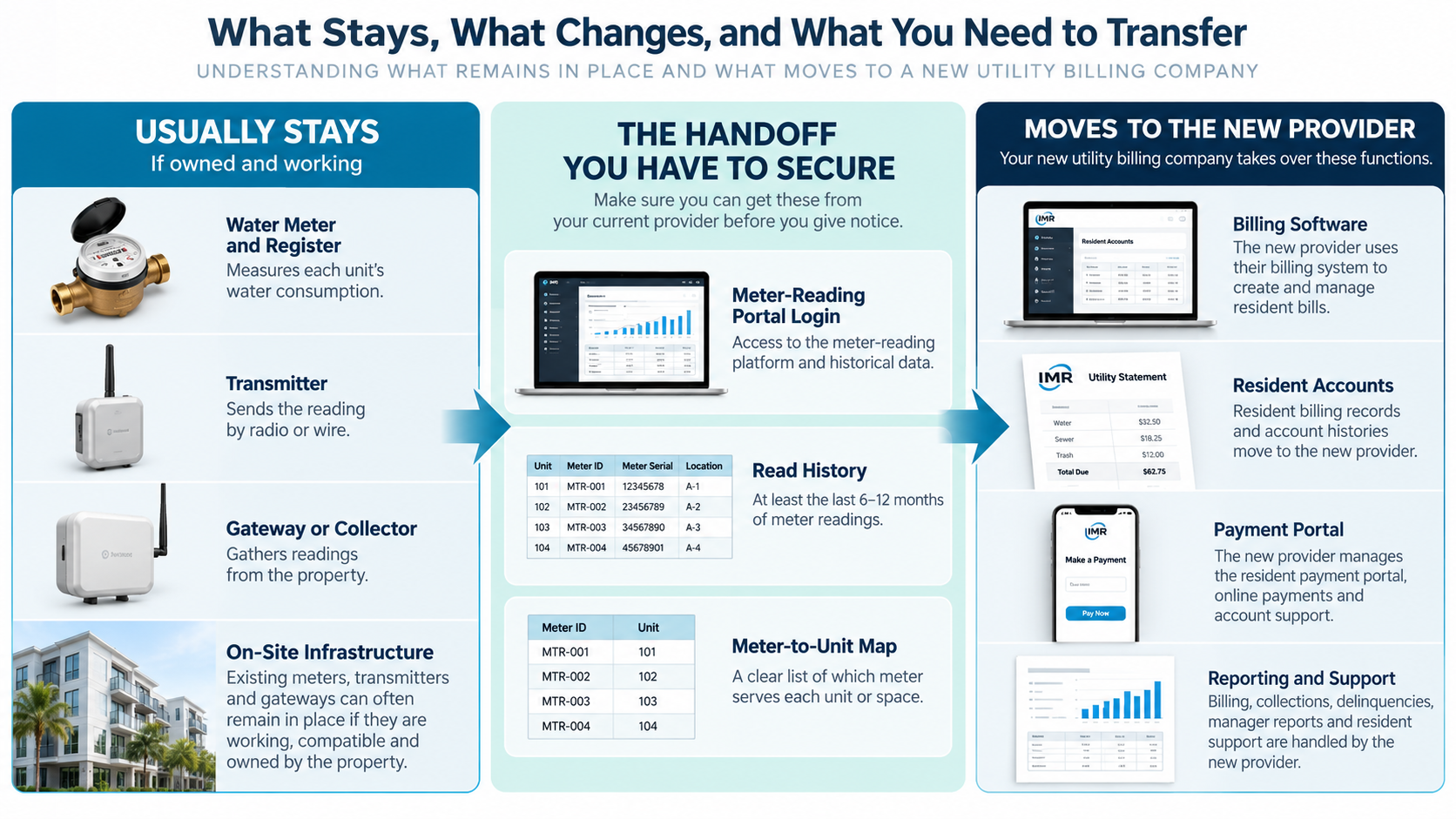
What stays, what changes, and what must transfer when switching utility billing providers.
What to Verify Before Switching Providers
Water meters and registers: Confirm they're working, accurate, and assigned to the correct units.
Transmitters: Check whether they're reporting consistently or have recurring communication failures.
Gateways and repeaters: Determine who owns them and whether any cellular or service fees will continue after the transition.
Meter-reading platform: Confirm the property can authorize the new billing company to access the system.
Read history: Request 12 to 24 months of historical readings when available.
Resident accounts and balances: Establish who will collect outstanding balances and how account information will be transferred.
Payment portal and autopay: Plan for residents to register with the new payment system and reestablish automatic payments where necessary.
Who Controls Your Meter Data?
This is the question most property owners don't ask until they're halfway through switching providers.
Owning the water meters doesn't necessarily mean you control the information they collect.
Meter readings may be stored in a third-party platform or gateway account established by the current billing company. If that company controls the only account with access, switching providers becomes more complicated.
Before terminating your agreement, ask:
• Who is the account holder on the meter-reading platform?
• Does the property have its own administrator login?
• Can the property authorize another company to access meter readings?
• Can historical meter data be exported, and in what format?
• Are there fees for transferring data or changing account access?
These questions matter beyond the billing transition.
Reliable historical meter data helps resolve resident billing disputes, identify missing readings, verify consumption, and detect abnormal water usage.
On compatible systems, the same data can also support continuous leak monitoring without requiring an entirely new metering system.
Learn more about IMR's Leak Alert Resolution System (LARS) and how existing meter data can help properties identify water leaks earlier.
Before You Give Notice: The Steps Most Properties Skip
The best time to prepare a switch is before you send termination notice to your current utility billing company.
Once notice goes out, you may be depending on a departing provider to supply critical information. A little preparation now can prevent weeks of frustration later.
1. Review your existing contract. Identify the expiration date, automatic renewal terms, required notice period, and any early termination fees. Your contract may determine when the transition can actually happen.
2. Export your billing and meter data. Request 12 to 24 months of meter readings where available, meter serial numbers, meter-to-unit assignments, billing rates, and resident account records.
3. Secure access to your meter-reading platform. Confirm the property has its own login and can authorize a new provider to access the readings. Don't assume owning the meters automatically gives you access to the software.
4. Identify equipment problems before the transition. Review nonreporting meters, failed transmitters, gateway communication issues, and incorrect meter-to-unit assignments. Fixing these issues early makes the first billing cycle easier to manage.
The goal isn't simply to end one contract and start another. It's to make sure the property retains control of the information needed to bill residents accurately.
Questions to Ask Your Current Billing Provider Before Terminating
Before sending notice, get clear answers to these questions:
What will be the final billing period, and when will the last meter readings be taken?
Will you provide a complete data export, and when?
Can you transfer or release access to the meter-reading platform?
Are any gateways, transmitters, or service plans owned or controlled by your company?
How will outstanding resident balances be handled?
When will the current payment portal and automatic payments stop?
Get the answers in writing. A documented transition plan protects the property, the incoming provider, and the residents.
The Utility Billing Transition, Step by Step
Once the meter data, account information, and system access are secured, the actual transition can begin.
A successful utility billing company change requires coordination between the outgoing provider, incoming provider, property management team, and sometimes the meter-reading platform vendor.
The most important part is establishing a clear cutover date so the last bill from the outgoing company and the first bill from the new company account for the correct consumption periods.
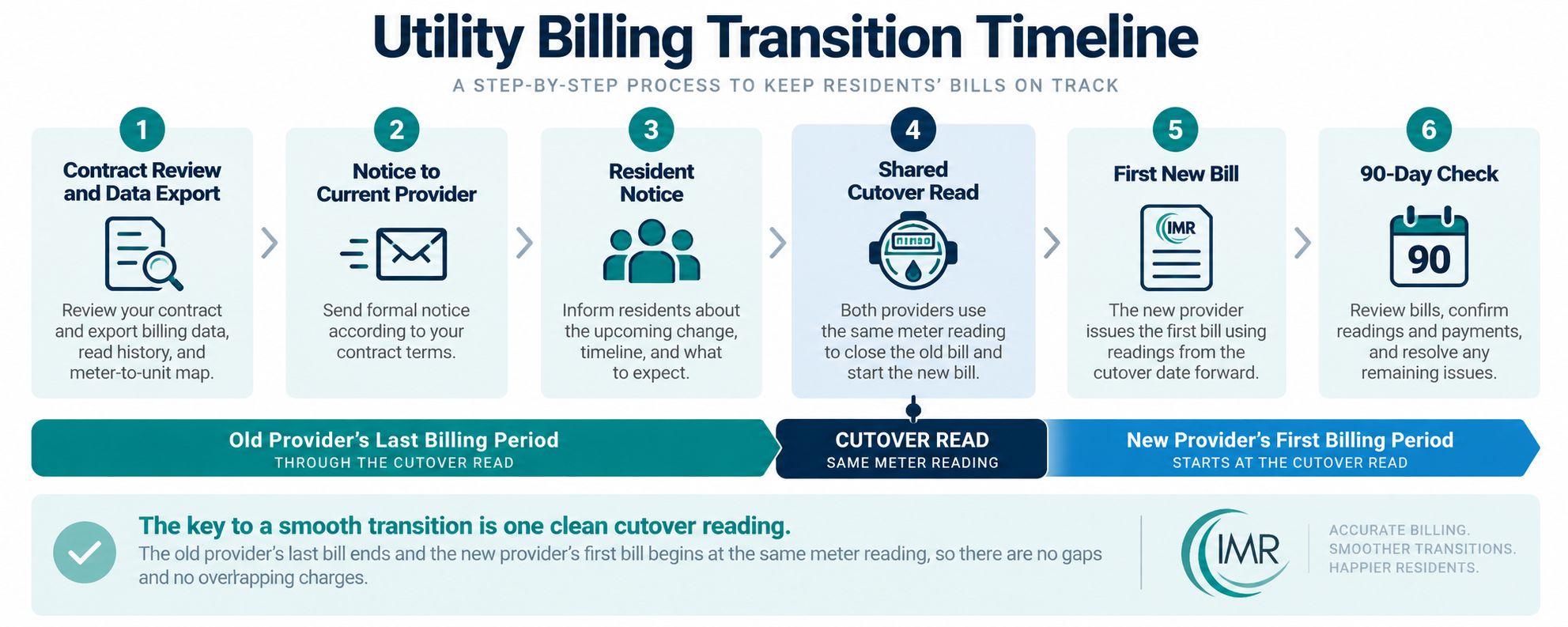
A successful utility billing transition starts with securing meter data and ends with verified resident bills. One shared cutover reading helps prevent duplicate charges and missing consumption.
The Cutover Read: How Residents End Up With a Double Bill or a Missing Month
This is where many resident billing complaints begin, and the problem often comes down to simple arithmetic.
Imagine the outgoing utility billing company issues Unit 204 its final bill using a meter reading of 125,000 gallons on October 31.
The incoming billing company must use that exact reading as the starting point for the next billing period.
What happens if it doesn't?
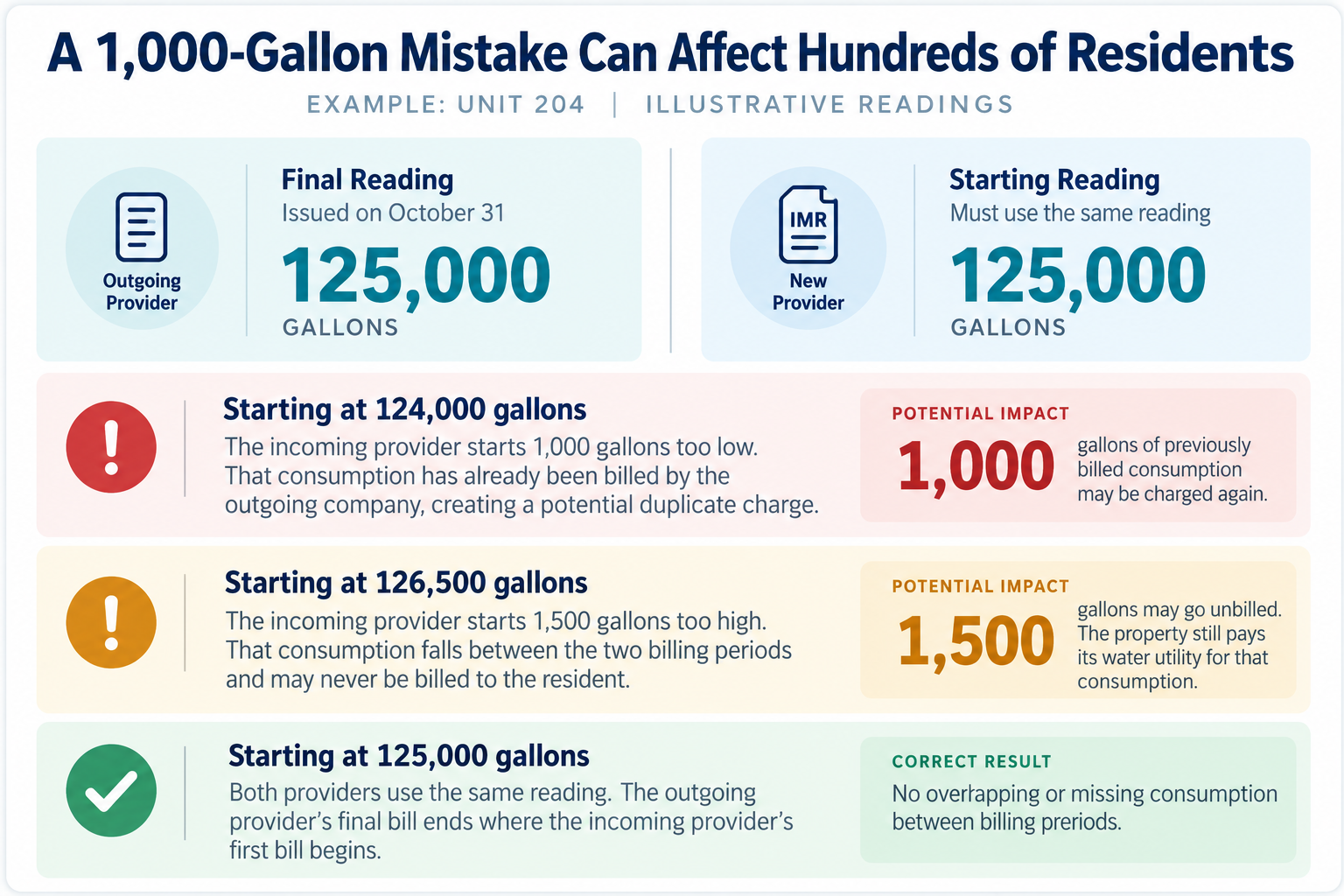
A difference of just 1,000 gallons might seem minor. Across a property with 200 apartments, however, incorrect starting readings can lead to resident disputes, duplicate charges, and lost billing revenue.
The solution is simple: Both utility billing companies must use the same verified cutover reading for each meter. The outgoing provider's final bill ends at that reading, and the incoming provider's first bill begins there.
Both providers should retain a record of the readings to resolve any questions that arise after the transition.
Checking the First Bill Before Residents See It
A meter reading can be perfectly accurate and still produce an incorrect resident bill.
A meter assigned to the wrong apartment, an incorrect multiplier, or a rate entered per gallon instead of per thousand gallons can create billing errors even when the meter itself is working correctly.
Before the first new bills are issued, the incoming billing company should:
Verify meter-to-unit assignments and billing rates.
Compare each unit's consumption against recent billing history.
Flag unusually high, low, or zero consumption.
Review the total billed consumption against the property's master water meter and utility records, accounting for common-area usage and other differences.
Investigate discrepancies before residents receive their statements.
The first billing cycle is more than a routine billing run. It's an opportunity to identify problems that may have existed long before the provider transition.
Keeping Residents Informed During a Utility Billing Transition
Residents don't need to understand every technical detail of a billing transition.
They need four things:
Who will send their utility bill.
When they should expect the first new statement.
How and where to make payments.
Who to contact with questions.
A short notice sent two to four weeks before the first new bill can help prevent confusion, especially when residents need to establish a new payment account or re-enroll in automatic payments.
Two common sources of first-month questions are automatic payments that no longer work and a first bill covering a different number of days than usual.
Address both in advance.
Sample Resident Notice: Utility Billing Provider Change
NOTICE TO RESIDENTS
Subject: Upcoming Change to Your Water and Sewer Billing Provider
Starting with your [month] bill, water and sewer billing for [property name] will be handled by [new billing provider].
Your water service and existing meter will remain unchanged.
Your final bill from [previous provider] will cover consumption through [cutover date]. Your first bill from [new provider] will begin from that same meter reading to prevent overlapping charges.
Important payment information:
If you currently use automatic payments, please follow the new provider's enrollment instructions at [portal link] before [date]. Automatic payments may need to be set up again.
For questions about your new utility bill, contact:
[New Provider Name] [Phone Number] [Email Address]
Thank you for your cooperation during this transition.
Switching Utility Billing Companies in Florida: What Property Managers Should Know
Changing utility billing providers in Florida involves more than transferring meter readings. Property managers should also verify that the property's billing practices, resident agreements, and utility charges remain consistent with applicable requirements.
This is particularly important because multifamily apartments, condominiums, homeowners associations, and mobile home communities may operate under different legal and contractual arrangements.
For properties in Broward, Miami-Dade, and Palm Beach counties, the transition should include a review of the following:
Resident leases and governing documents. Confirm how utility charges are authorized, calculated, and communicated.
Water and sewer billing methods. Verify whether the property uses individual submeters, an allocation method, or another approved arrangement.
Rates and administrative charges. Review how charges are calculated and whether they comply with applicable requirements.
Resident notifications. Confirm whether leases, governing documents, contracts, or applicable rules require advance notice.
Billing records. Preserve historical readings, account information, adjustments, and documentation needed to address future disputes.
A change in billing companies does not automatically authorize a change in how residents are charged.
The safest approach is to review these details before the first billing cycle rather than discovering a problem after statements have been issued.
Does Switching Billing Companies Require Replacing Water Meters?
Not necessarily. Many Florida properties can change utility billing providers while continuing to use their existing water submeters and transmitters.
The determining factors are equipment compatibility, meter condition, ownership, and access to the meter-reading platform.
For example, a property using a compatible automated meter-reading system may be able to authorize a new billing provider to retrieve readings without installing new hardware.
However, proprietary equipment, provider-owned gateways, or restricted data access can complicate the process.
Before approving a meter replacement project, ask the incoming billing company to evaluate the existing system.
Utility Billing Company Transition Checklist
Before changing utility billing providers, use this checklist to confirm that your property is ready.
A successful transition depends on more than signing a new agreement. The meter data, billing records, equipment access, resident communication, and final billing dates all need to line up.
10-point transition checklist
Review the current billing agreement and termination requirements
Request historical meter readings and resident billing records
Confirm meter-to-unit assignments and equipment ownership
Secure access to the meter-reading platform
Identify nonreporting meters and unresolved equipment issues
Agree on the final billing date and shared cutover readings
Confirm how outstanding balances and adjustments will be handled
Notify residents and provide new payment instructions
Validate the first billing cycle before issuing statements
Review billing discrepancies and resident questions after the transition
How IMR Billing Services Helps Properties Switch Providers
At IMR Billing Services, we believe changing utility billing companies shouldn't create more work for property managers.
Our approach begins with understanding the property's existing metering system, billing arrangements, and operational needs before establishing a transition plan.
We focus on five areas:
1. Existing system evaluation. We review the property's water submeters, transmitters, meter-reading platform, and available data to determine what can remain in place.
2. Meter data and account setup. We coordinate access to available meter readings, verify unit assignments, and prepare the information needed for resident billing.
3. Billing continuity. We work with property management to establish the cutover date, review billing calculations, and prepare for the first billing cycle.
4. Local field support. When meters, transmitters, or communication equipment need attention, our South Florida field support helps address the underlying issue rather than allowing it to become another recurring billing problem.
5. Leak detection and monitoring. For compatible systems, IMR's Leak Alert Resolution System (LARS) can use existing meter data to identify abnormal consumption and potential leaks.
Our objective is straightforward: accurate resident billing, dependable meter data, and fewer billing problems landing on the property manager's desk.
Serving Broward, Miami-Dade, and Palm Beach counties, IMR provides utility billing, submetering support, revenue recovery, and leak-detection services for multifamily communities and other properties.
Frequently Asked Questions About Switching Utility Billing Companies
Can you switch utility billing companies without replacing water meters?
Yes, in many cases. If the property's existing meters and transmitters are compatible and the incoming provider can access the reading data, replacing the equipment may not be necessary. Equipment ownership and platform permissions should be verified first.
How long does it take to switch utility billing providers?
The timeline depends on the existing contract, notice requirements, meter-data access, and billing cycle. Some transitions can be completed within a billing cycle once the necessary information is available. Others take longer because of contract restrictions or equipment issues.
Who owns the water meter data when changing billing companies?
Meter ownership and data access are not necessarily the same thing. The property's agreement with its current provider and the meter-reading platform's account permissions can determine who controls access. Property managers should request historical readings and clarify data-access rights before terminating service.
What happens to outstanding resident balances when switching billing companies?
Outstanding balances, credits, adjustments, and payment responsibilities should be addressed in writing before the transition. The property and both providers should agree on who will manage previous charges and how residents will receive accurate account information.
How can a property avoid double billing during a utility billing transition?
Both providers should use the same verified cutover reading for each meter. The outgoing company's final billing period must end where the incoming company's first billing period begins. Reviewing the first billing cycle helps identify discrepancies before they reach residents.
What should I ask my current utility billing company before switching?
Ask about contract termination requirements, meter and transmitter ownership, access to historical readings, meter-to-unit assignments, equipment compatibility, outstanding resident balances, and the process for obtaining final billing records.
Thinking About Changing Utility Billing Companies? Start With a Billing Review.
Switching utility billing companies doesn't have to mean replacing meters, disrupting residents, or starting from scratch.
At IMR Billing Services, we help South Florida property owners and managers evaluate their current utility billing setup, identify potential transition obstacles, and determine what can be reused.
Whether you're dealing with inaccurate bills, limited access to meter data, poor customer service, or simply looking for a more dependable billing partner, the first step is understanding your options.
Serving Broward, Miami-Dade, and Palm Beach counties.
Request a free billing review and find out what it would take to make the switch.