
It's the end of the billing cycle. Your community has 200 apartments, and most of the water meters are reporting normally.
But ten aren't.
Now the questions begin. Did those meters stop working? Are residents still using water? Can the missing readings be recovered? And what happens to the bills that need to go out?
For multifamily property managers, missing water-meter readings are more than a technical inconvenience. They can affect billing accuracy, delay resident charges, generate customer service calls, and complicate utility expense recovery.
But here's the distinction that matters most:
An apartment water meter that isn't reporting may still be measuring water correctly.
The problem could be with the register, transmitter, communications network, software integration, or even the apartment assignment.
Understanding where the information stopped moving is the first step toward fixing the problem without creating another one.
A Missing Water Reading Doesn't Always Mean a Broken Meter
When a property manager hears that a meter is offline, it's natural to assume the meter itself has failed.
Sometimes that's the case. But not always.
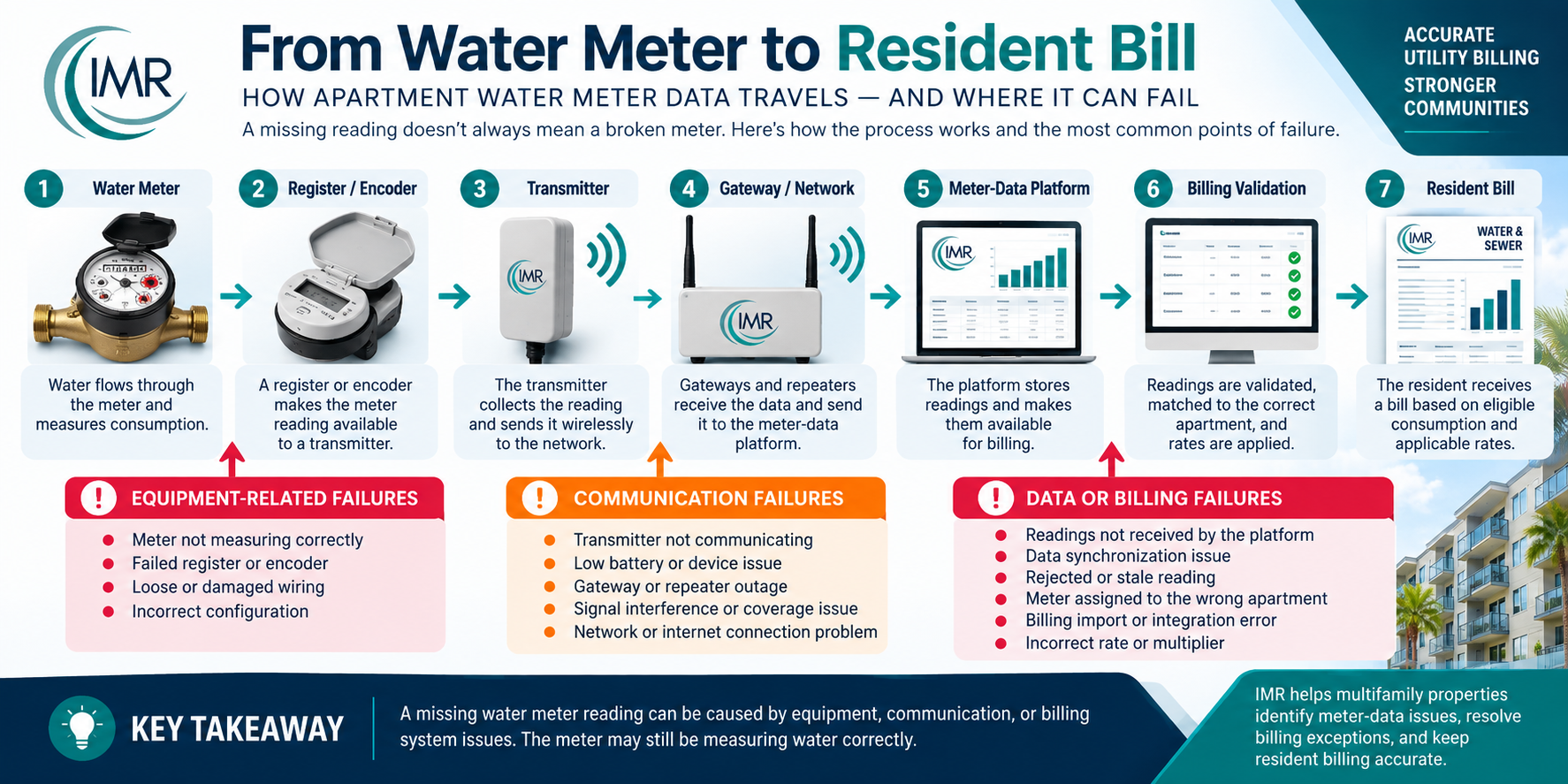
Think of an automated water submetering system as a chain. Water flows through the meter. The meter measures consumption. Depending on the equipment, a register or encoder makes that information available to a transmitter. A communications system collects the reading, and the data eventually reaches the billing platform.
Every connection matters.
A water meter could be accurately measuring consumption while a failed transmitter prevents the billing company from receiving the reading.
Or the transmitter could be working perfectly, but the meter is assigned to the wrong apartment in the software.
In another situation, the meter data may be available in the collection platform but missing from the billing import.
These problems may produce similar-looking reports, yet each requires a different solution.
The key question isn't simply, "Is the meter working?" It's, "Where did the reading stop?"
How Water Meter Data Reaches a Resident's Bill
At a property with automated water submeters, information typically travels through several stages.
Not every property uses the same equipment. Manual-read systems, walk-by systems, and fixed-network systems collect data differently.
But the principle is the same: measuring consumption and successfully billing that consumption are separate operations.
A problem at any point can interrupt the process.
For example, the meter may have a valid current reading, but the billing platform may still be using a reading from several weeks earlier.
That's why a reliable billing process needs more than access to meter data. It needs to verify that the information is current, reasonable, and assigned to the correct apartment and billing period.
Missing, Zero, Stale, and Estimated Readings: Why the Difference Matters
One of the most important parts of utility billing is knowing what the meter data actually represents.
A missing reading, a zero-usage reading, a stale reading, and an estimated reading may look similar on a billing report—but they mean very different things.
Understanding the difference helps property managers avoid unnecessary billing errors and identify which apartments need further investigation.
MISSING READING
No usable reading is available for the billing period.
What to do: Investigate before determining the appropriate billing treatment.
ZERO USAGE
Valid readings indicate no measured water consumption during the billing period.
What to do: Verify that zero consumption is reasonable for the apartment and supported by valid readings.
STALE READING
The most recent reading is older than the required billing period.
What to do: Confirm the last valid reading date and investigate why newer data hasn't arrived.
ESTIMATED READING
Consumption is calculated using an estimate rather than established entirely from current actual readings.
What to do: Verify that the estimate is permitted, properly calculated, and documented before billing.
What This Looks Like During a Billing Cycle
Imagine an occupied apartment where the last valid water meter reading was recorded on September 15.
The October billing cycle closes on October 15, but no newer reading is available.
Does that mean the resident used zero gallons?
Not necessarily.
It means the billing system doesn't have the information needed to establish actual consumption for that period.
If zero is incorrectly substituted, the resident may be underbilled. If an unsupported estimate is used, the resident could be overbilled or underbilled. And if missing consumption is added to a later bill without proper review, the resident may receive an unexpected charge.
The IMR takeaway: A missing reading should trigger an investigation, not an assumption.
Why Do Apartment Water Submeters Stop Reporting?
There isn't one universal cause. The answer depends on the property's meter equipment, communications system, and billing workflow.
Before replacing a meter or transmitter, it's important to identify where the reading stopped moving. Here are five common areas worth investigating.
1. The Transmitter Is No Longer Communicating
A transmitter may stop sending usable data because of battery depletion, damage, configuration problems, or another device-specific issue.
The physical water meter may continue measuring consumption even though the transmitter is offline.
A qualified technician may need to compare the meter's local reading with the device's communication status.
IMR field insight: A transmitter that stops communicating doesn't automatically mean the water meter needs to be replaced. First, determine whether the problem is with measurement, communication, or both.
2. The Meter Register or Encoder Has a Problem
In systems with separate registers or encoders, the transmitter may be communicating normally while the meter information it receives is incomplete or incorrect.
Damaged wiring, an incompatible register, or an incorrect configuration can interrupt that connection.
This is why seeing a transmitter online doesn't necessarily mean the correct water consumption is being recorded.
IMR field insight: Before replacing equipment, verify that the register, transmitter, and meter configuration are compatible and that the reading matches the physical meter.
3. The Gateway or Communications Network Is Interrupted
Automated meter-reading systems may depend on gateways, repeaters, and internet or cellular connections to deliver meter data.
When several apartments stop reporting around the same time, the problem may involve shared communications equipment rather than individual meters.
For example, a gateway outage could interrupt readings from multiple apartments in the same building.
IMR field insight: Look for patterns. One meter offline may point toward an individual device. Several meters offline together may point toward a gateway, repeater, or network issue. Neither pattern proves the cause without further investigation.
4. The Meter Data Isn't Reaching the Billing Software
Sometimes the meters are working, the transmitters are communicating, and the readings are available in the meter-data platform.
But the billing software still doesn't have them.
A failed data import, synchronization issue, rejected reading, or integration problem may prevent current consumption from reaching the resident's account.
IMR billing insight: Replacing a meter won't solve a software problem. Before sending a technician into the field, verify whether the reading exists in the collection platform and whether it was successfully transferred into the billing system.
5. The Meter Is Assigned to the Wrong Apartment
This problem can arise during property onboarding, equipment replacement, renovations, or resident turnover.
A meter may be reporting accurate consumption while its identification number is associated with the wrong apartment in the billing system.
The property's overall consumption may look reasonable, but individual residents could be charged incorrectly.
IMR billing insight: A meter-to-unit mapping review can be just as important as checking the physical equipment. Accurate readings only help when they're connected to the correct resident account.
What Happens to Resident Billing When Meter Readings Are Missing?
The financial impact depends on what failed, how long the issue lasted, and whether the missing information can be recovered. Understanding these billing exceptions is an important part of protecting a property's utility expense recovery.
A missing reading may lead to:
Delayed resident charges.
Estimated consumption, where permitted and properly documented.
Billing corrections after verified readings become available.
Additional administrative work and resident service calls.
Disputes over charges or billing periods.
Charges that cannot appropriately be recovered.
But these outcomes are not the same.
A missing reading is not automatically lost revenue. Sometimes the information can be recovered before billing. Other times, adjustments may be necessary. And in some cases, the available records may not support billing the consumption at all.
For IMR, the priority is identifying which charges are supported by reliable data, which require further investigation, and which can appropriately be billed under the property's applicable requirements.
A 200-Apartment Example: What Could Be at Stake?
Consider a hypothetical multifamily community with 200 apartments.
At the end of the billing cycle, 10 water meters have missing readings.
For illustration, assume each affected apartment would otherwise have 3,000 gallons of eligible water and sewer consumption, with a hypothetical combined billing rate of $13 per 1,000 gallons.
Here's what those missing readings could represent:
ILLUSTRATIVE BILLING EXAMPLE
Apartments in the community: 200
Apartments with missing readings: 10
Assumed consumption per affected apartment: 3,000 gallons
Hypothetical combined water and sewer rate: $13 per 1,000 gallons
Potential charge per affected apartment: $39
TOTAL CHARGES REQUIRING REVIEW: $390
This example is hypothetical. The $390 represents potential billing exposure—not confirmed lost revenue.
That $390 is not necessarily lost revenue. It's an amount that needs to be investigated.
If the missing readings are recovered before billing, the appropriate eligible charges may be included in the normal billing cycle.
If the readings become available after billing, adjustments may be necessary, depending on the available records and applicable billing requirements.
And if the information cannot support the charges, some amounts may not be recoverable.
The IMR takeaway: Finding a missing reading is only half the job. Making sure the resident's billing account is handled correctly is what completes the process.
What Should a Property Manager Check Before the Billing Cycle Closes?
When water meter readings go missing, the solution isn't always to send someone out to replace equipment.
Sometimes the problem is in the field. Sometimes it's in the software. And sometimes it's simply a meter assigned to the wrong apartment.
Before the billing cycle closes, property managers and billing teams should work through a few important checks.
PRE-BILLING METER EXCEPTION CHECKLIST
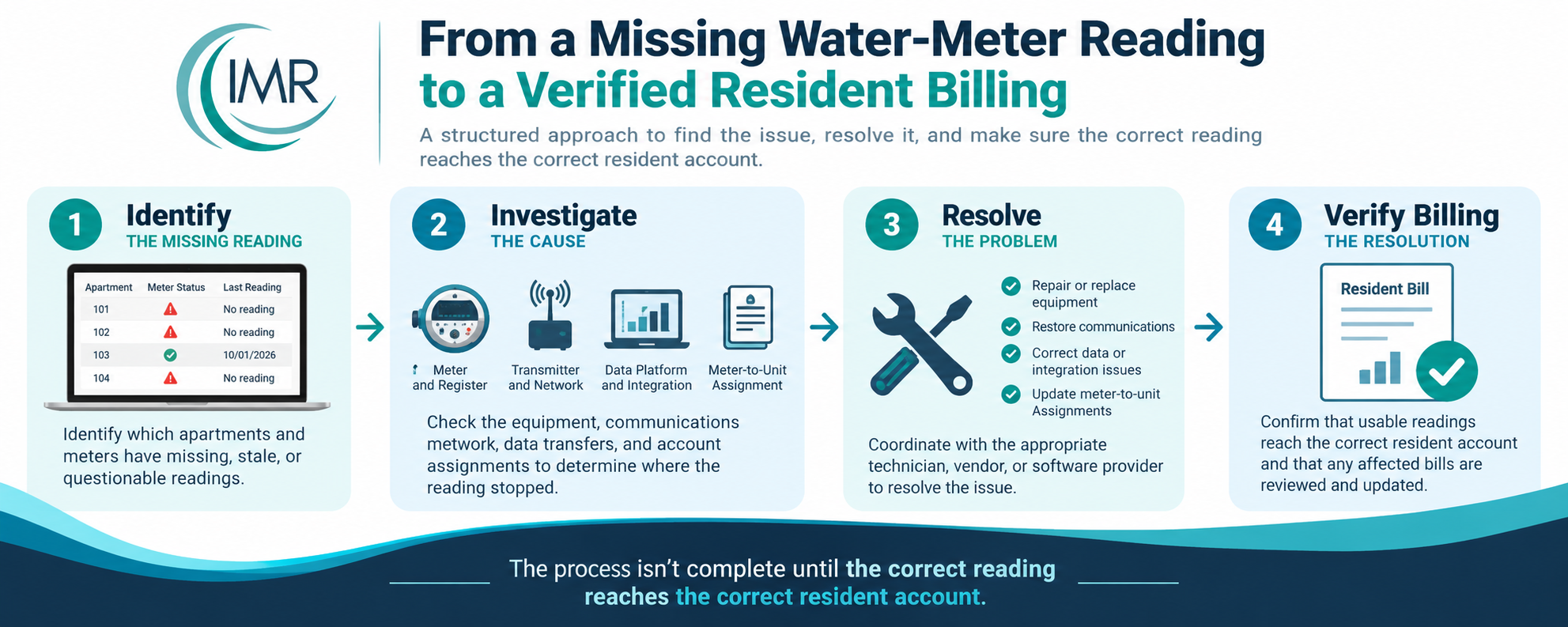
Identify affected apartments. Determine which meters have missing, stale, or questionable readings.
Check the last valid reading. Confirm when the consumption was actually measured, not just when the software displayed it.
Verify meter-to-unit assignments. Match the meter ID, transmitter, apartment number, and applicable occupancy records.
Look for patterns. Are the missing readings isolated, concentrated in one building, or affecting several properties?
Find where the data stopped. Check whether readings are missing from the meter platform or only from the billing software.
Assign the right technician or vendor. Coordinate equipment diagnostics, network troubleshooting, or software support as needed.
Document the correction. Record meter readings, device replacements, configuration changes, and relevant dates.
Verify billing resolution. Confirm that usable readings reach the correct resident accounts and that any affected bills are reviewed.
Who Is Responsible for Fixing a Missing Water-Meter Reading?
When a meter stops reporting, one of the biggest challenges isn't always identifying the problem. It's figuring out who needs to take the next step.
Not every issue requires a plumber. Not every missing reading requires a technician. And not every billing discrepancy starts with the meter.
Here's how responsibilities are typically divided:
Utility billing provider: Identifies missing or questionable readings, reviews consumption and account assignments, and coordinates appropriate billing corrections.
Property management: Confirms occupancy information, coordinates access, communicates with vendors, and approves necessary actions.
Field technician or equipment vendor: Diagnoses supported meter, transmitter, and communications equipment issues and verifies repairs or replacements.
Software or integration provider: Investigates data transfers, synchronization problems, rejected imports, and platform access.
Qualified plumber: Handles physical meter installation or plumbing repairs when necessary.
Actual responsibilities depend on the property's equipment and service agreements.
The IMR perspective: The goal isn't simply to assign blame when a reading goes missing. It's to make sure someone owns the issue—and follows it through until the resident's billing record is correct.
Can Missing Water Meter Readings Be Recovered Later?
Sometimes, yes. But there's an important distinction between recovering a meter reading and knowing exactly when the water was used.
Many water meters use cumulative registers that increase as consumption is measured.
If two verified cumulative readings are available, it may be possible to calculate total consumption between them, assuming the readings are comparable and any meter replacements, rollovers, or configuration changes are properly accounted for.
But knowing total consumption across a gap doesn't necessarily tell you exactly when that water was used.
For example, a meter might show that 6,000 gallons were consumed across two months. That doesn't automatically establish whether 2,000 gallons were used in the first month and 4,000 in the second.
This becomes especially important when a resident moves in or out, rates change, a previous bill was estimated, or the missing period crosses multiple billing cycles.
The IMR takeaway: Restoring communication solves the technical problem. Verifying what can appropriately be billed solves the resident billing problem.
Missing Water Meter Readings: What Florida Property Managers Should Know
For multifamily properties in South Florida, missing water meter readings can create questions that extend beyond equipment troubleshooting.
Property managers in Broward County, Miami-Dade County, and Palm Beach County need to consider how missing consumption data affects resident billing, utility expense recovery, and account accuracy.
The appropriate response depends on the property's billing method, resident agreements, applicable requirements, and the records available to support each charge.
For example, a property using individual water submeters may need to verify actual consumption before determining whether an adjustment or estimate is appropriate. A property using an allocation method such as RUBS follows a different billing process and may face different data requirements.
There is no universal rule that every missing water meter reading can be estimated or billed later.
Before making adjustments, property teams should confirm the applicable requirements, document the available evidence, and make sure residents are charged appropriately.
IMR's local perspective: Whether a community is in Fort Lauderdale, Hollywood, Pembroke Pines, Miami, or West Palm Beach, reliable utility billing requires more than functioning equipment. It requires accurate meter data, consistent account management, and a clear process for resolving exceptions.
How proactive monitoring helps prevent billing surprises
Finding out that ten apartment water meters haven't reported at the end of the billing cycle is frustrating.
Finding out earlier gives the property team more time to investigate.
Regular reviews of meter communication status, reading dates, and consumption patterns can help identify problems before they affect resident billing.
For example, a meter that hasn't submitted a current reading may need a communications check. A meter reporting zero consumption may need further review to determine whether the reading is reasonable. And a meter showing continuous water usage may indicate a potential leak.
These are different problems, and they require different responses.
That's where IMR's approach to utility management becomes valuable. We look beyond simply producing monthly resident bills. Meter-data review, billing validation, field coordination, and usage monitoring can help property managers identify exceptions and work toward resolving them.
IMR's Leak Alert Resolution System (LARS) adds another layer of visibility by analyzing water-consumption patterns for potential leaks and supporting the process of identifying, prioritizing, notifying, and verifying resolution.
An important distinction: LARS is a leak-monitoring solution, not a substitute for meter communication diagnostics or billing validation.
The strongest utility management process brings these capabilities together so property managers can address problems before they become larger operational or billing headaches.
Frequently Asked Questions About Missing Apartment Water Meter Readings
-
An apartment water meter may stop reporting because of a transmitter issue, depleted battery, register or encoder problem, gateway outage, communications failure, or software integration error. The meter itself may still be measuring water correctly. The first step is identifying where the reading stopped moving.
-
Yes. In many systems, the physical meter continues measuring water even when its transmitter or communications network is offline. However, the availability of historical readings depends on the equipment and data collection system.
-
Estimated billing may be possible in some circumstances, but it depends on applicable laws, resident agreements, billing methods, and documentation. Property managers should verify the requirements before substituting an estimate for an actual meter reading.
-
Sometimes. A later verified cumulative reading may help establish total consumption across a missing period. However, it may not show exactly when the water was used or how consumption should be allocated across billing periods.
-
The appropriate party depends on the cause. A billing provider may identify the exception, an equipment technician may troubleshoot the transmitter or gateway, a software provider may investigate missing imports, and a qualified plumber may be needed for physical meter or plumbing work. Property management typically helps coordinate access and approvals.
Missing Water Meter Readings at Your Property? Let's Find Out Why.
A missing water meter reading doesn't always mean a broken meter. And it doesn't have to become a resident billing problem.
At IMR Billing Services, we help multifamily property managers understand what's happening between their water meters and their resident billing accounts.
From reviewing meter data and identifying billing exceptions to coordinating field troubleshooting and supporting accurate utility billing, our goal is straightforward: find the issue, determine the right solution, and help get the billing process back on track.
Serving multifamily communities throughout Broward County, Miami-Dade County, Palm Beach County, and beyond.
Not sure why your apartment water meters aren't reporting? Let's take a closer look.