
An unexplained water bill doesn't always mean a leak. Sometimes the problem is in the meter, the data, or the billing process. Here's how to recognize the warning signs before they become recurring expenses.
Imagine reviewing your property's monthly financials and noticing something that doesn't quite add up.
Occupancy is steady. There haven't been any major plumbing repairs. Residents are receiving their water bills, and nothing seems unusual.
Yet the property's water expense keeps climbing.
Is there a hidden leak? Are the submeters recording correctly? Is the billing system receiving the right information? Or is the property simply using more water than it did last month?
The answer isn't always obvious. A transmitter can stop communicating while the meter keeps measuring. A small toilet leak can run for weeks without a maintenance request. A meter assigned to the wrong unit can create billing errors even when the equipment works perfectly. And sometimes what looks like missing revenue is simply water used somewhere that was never individually metered.
The short answer: yes, a property can lose money through its water meters without anyone noticing—through unrepaired leaks, readings that never arrive, estimates that never get corrected, or bills tied to the wrong meter. But a gap in the numbers is a reason to investigate, not proof of a leak or of revenue you're entitled to recover.
Here are seven warning signs worth investigating.
First, Separate the Three Numbers
Before looking at the meters, it helps to separate three numbers that are often blurred together:
1. What the property pays for water. This starts with the master utility bill, based on consumption at the utility's service meter plus applicable rates and charges.
2. What the property bills residents. Depending on the billing arrangement, individual submeter readings or an approved allocation method determine resident charges.
3. What the property actually collects. Issuing a correct bill and receiving payment are two different things.
These numbers don't have to match. Common-area use, vacant units, billing schedules, authorized charges, and collections all create legitimate differences. But the differences should be explainable.
| What you're reviewing | The question to answer |
|---|---|
| Water consumption | Where did the water go? |
| Resident billing | Was the correct consumption billed appropriately? |
| Collections | Were the billed amounts actually collected? |
| Leak and maintenance records | Were abnormal conditions investigated and resolved? |
A problem in one area doesn't mean there's a problem in another. That's why good utility management starts with accurate information, not assumptions.
1. Your Master Water Bill and Submeter Readings Don't Add Up
The master meter measures water entering the property. Individual submeters measure consumption at specific units or locations. In theory, the two should tell a consistent story. In practice, they rarely match exactly.
Irrigation, pools, laundry rooms, maintenance, and other common areas may never appear on resident submeter reports. Different reading dates can make the numbers look further apart than they are. Unit mismatches cause false gaps too: many utilities bill in CCF (100 cubic feet, about 748 gallons) while submeter reports run in gallons.
There's also a plumbing reason. A meter only measures water that passes through it. A leak on the supply side of a unit's submeter—in a riser, a common line, or a service pipe—registers on the master meter but never on any resident's meter.
The warning sign isn't that the numbers differ. It's that the difference stays unexplained month after month.
A Simple Example (Hypothetical)
A property records 1,000,000 gallons on its master meter during a billing period. Its resident submeter report shows 780,000 gallons.
At first glance, that's a 220,000-gallon difference.
Further review identifies:
90,000 gallons of documented common-area use.
30,000 gallons from vacant units and maintenance activity.
40,000 gallons accounted for after aligning meter-reading dates.
That leaves 60,000 gallons unexplained. The original 22% gap has become a 6% residual that deserves a closer look.
It doesn't prove there's a leak, and it doesn't mean those gallons can be billed to residents. But it gives management a far better starting point.
What to check: Compare identical reading periods, confirm units (gallons vs. CCF) and meter multipliers, account for common-area use, and list any meters that stopped reporting during the period.
A reconciliation gap is something to explain—not automatically something to charge.
2. Water Use Keeps Rising, but Occupancy Hasn't Changed Much
Water expenses rise for legitimate reasons. Rates change, billing periods vary, irrigation demand shifts, and maintenance teams sometimes use more water than usual.
So start by separating two questions: Is the property paying more per gallon, or is it using more gallons? Those are very different problems.
If gallons are rising, look for patterns. Is the increase concentrated in one building? Does consumption stay elevated overnight? Are certain units using more than their own history suggests?
One of the most overlooked sources is a running toilet. A worn flapper lets water slip from the tank into the bowl, often silently. The resident may never notice, and maintenance may never get a work order. EPA WaterSense estimates the average household's leaks waste more than 9,300 gallons a year, names worn flappers among the most common culprits, and recommends replacing flappers at least every five years.
In a multifamily community, modest problems add up when they run for weeks or appear in several units at once.
Vacant units offer a useful check. EPA suggests reading a meter before and after a stretch when no water is being used; any movement points to a leak. An occupied building's master meter never truly rests, but a vacant unit's submeter should. Steady overnight movement on an empty unit is worth a work order.
What to check: Compare gallons, not just dollars. Review consumption against occupancy, billing days, irrigation schedules, and known maintenance. Investigate persistent changes rather than reacting to one unusual month.
3. Some Water Meters Have Stopped Reporting
A water meter can be working perfectly while the billing platform receives no new readings. That's one of the most important distinctions in submetering.
The meter measures water. Depending on the system, a register records the measurement, a transmitter sends it, and a gateway or network carries it to a data platform. If any link in that chain fails, the reading may not reach billing—but the meter may still be measuring.
A dead transmitter battery, a damaged connection, an incorrect device setting, or a gateway outage can all interrupt reporting. The result is missing readings, delayed bills, or estimates. The longer it goes on, the messier the billing history becomes.
(For a deeper walkthrough, see our guide on why apartment water meters stop reporting.)
Missing, Stale, Frozen, and Zero Readings Are Not the Same Thing
| Reading condition | What it may mean |
|---|---|
| Missing reading | No usable reading arrived for the expected period |
| Stale reading | The latest reading is older than it should be |
| Frozen reading | The same value keeps repeating, which can look like zero use but may be a stuck register or data feed |
| Zero consumption | Valid, current readings show no measured change |
| Estimated consumption | Usage was calculated without the required actual reading |
Treating these as interchangeable creates unnecessary billing problems.
If a transmitter stops communicating for two months, a later cumulative reading can establish total consumption during the outage. It may not show how much was used in each month—and that matters when preparing bills or corrections, especially if a resident moved in or out in between.
What to check: Ask for a report showing the last valid reading date for every meter. Note whether the problem affects single units or several devices in one building (which points to a gateway or network issue). Confirm the physical register is still advancing before deciding a meter needs replacement.
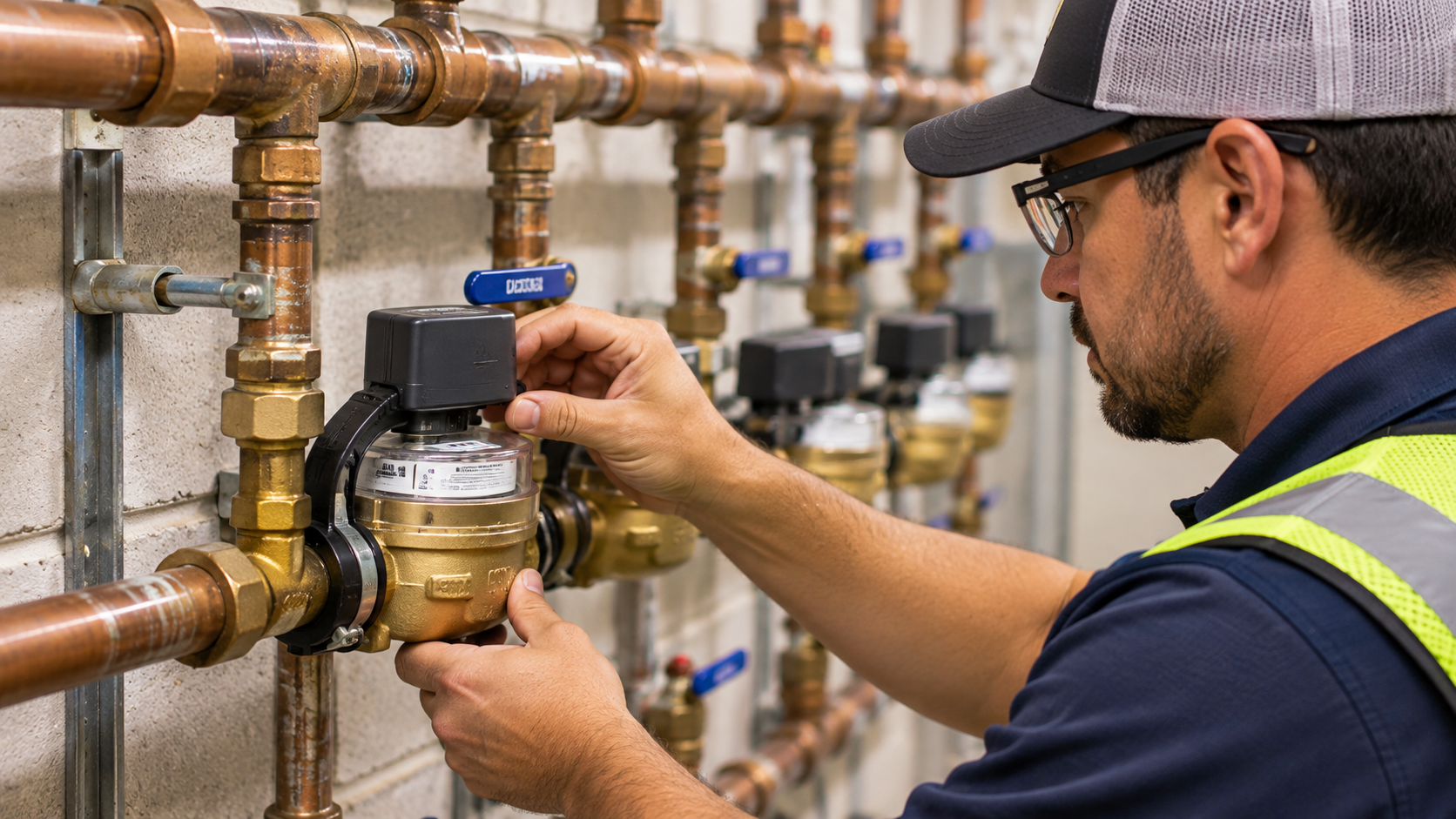
A missing reading doesn't always mean a failed meter. The problem may be in the register, transmitter, or communication network.
4. Estimated Readings Have Become Part of the Monthly Routine
Estimates serve a legitimate purpose. A temporary communication interruption shouldn't stop a whole property's billing cycle.
But using an estimate occasionally is different from relying on estimates because an underlying problem was never fixed.
Consider a unit estimated for three straight months. The resident keeps paying, and billing appears to be working. Then the meter starts reporting again, and the actual cumulative reading shows consumption was higher—or lower—than the estimates. Now someone has to reconcile the difference, decide on a correction, and explain it to the resident.
The rules that govern that correction can be strict. In Miami-Dade County's water remetering program, for example, estimated bills must be labeled as estimated, owners can't bill a resident for a previous resident's usage, and undercharges can be back-billed for no more than six months. Let estimates pile up and part of the correction may no longer be collectible.
What to check: Track how many accounts were estimated, how many consecutive cycles each has been estimated, the cause, and the documented plan to restore actual readings.
A temporary estimate keeps billing moving. Repeated estimates without investigation hide a growing problem.
5. Residents Keep Questioning Their Water Bills
Every property manager has heard from a resident who believes their water bill is too high. Sometimes the consumption is real—a running toilet or a change in the household. Sometimes the issue is in the billing setup.
A meter may be assigned to the wrong unit. A multiplier may be wrong. A reading may have landed in the wrong billing period. Even a perfectly working meter produces a wrong bill if its readings are tied to the wrong account.
That's why recurring complaints deserve more than another explanation of the charges. If several residents in the same building start questioning bills, look for what they have in common. Was equipment changed? Did the property switch billing providers? Were meters replaced or unit assignments updated? (Provider transitions are a common source; see how to switch utility billing companies without disrupting residents.) If billing problems point to a larger issue with your current provider, learn how to switch utility billing companies without disrupting residents.
How to Investigate a Disputed Bill
Confirm the resident's unit and occupancy dates.
Verify the meter serial number assigned to the unit.
Review the previous and current readings and their dates.
Check the measurement units (gallons or CCF) and multiplier.
Recalculate consumption and the authorized charges.
Review any estimates, equipment changes, or maintenance records.
The goal isn't to prove the resident wrong. It's to establish what actually happened. A clear answer backed by accurate readings resolves a legitimate question. And when an error turns up, fixing it promptly keeps it from repeating in the next cycle.
6. Leak Alerts Are Being Generated, but Nobody Knows Whether the Problem Was Fixed
Finding a possible leak matters. Making sure it gets resolved is where the real work happens.
A unit shows continuous water use for several nights. A monitoring system flags the pattern, and maintenance gets a notification. A technician replaces a toilet flapper and closes the work order.
But did the unusual consumption actually stop?
Without checking the readings afterward, you can't know. The flapper may have been the problem. Another fixture may have been involved. Or the pattern may have had a different cause entirely.
One caution: a quiet meter isn't proof the leak stopped. If the readings stopped arriving, the leak may still be running. Verification needs fresh readings that show normal use.
From Detection to Resolution
Identify → Prioritize → Notify → Repair → Verify
Spotting abnormal consumption is only the first step. Someone still has to evaluate it, inspect the suspected source, make the repair, and confirm the result.
Monitoring tools can help organize that work. IMR's Leak Alert Resolution System (LARS), for example, uses available meter data to identify and prioritize unusual consumption and support notifications to the people who need to act. But no monitoring system replaces an inspection or a repair, and a closed maintenance ticket doesn't by itself prove water use returned to normal.
What Can One Continuous Leak Cost? (Hypothetical)
Consider a fixture leaking at a constant 0.25 gallons per minute for 30 days:
0.25 gallons × 60 minutes × 24 hours × 30 days = 10,800 gallons
At illustrative rates of $5 per 1,000 gallons for water and $8 per 1,000 gallons for sewer:
| Expense | Illustrative 30-day cost |
|---|---|
| Water | $54.00 |
| Sewer | $86.40 |
| Combined | $140.40 |
That's one fixture under one set of assumptions. Actual cost depends on the leak rate, duration, your utility's rates, and how sewer is billed. These are not quoted South Florida rates or a customer result.
The point isn't the dollar amount. It's the duration. A problem found and fixed in a week is very different from one that runs through three billing cycles.
What to check: Review open leak alerts, maintenance response times, repeat service calls on the same unit, and whether anyone checked consumption after the repair.
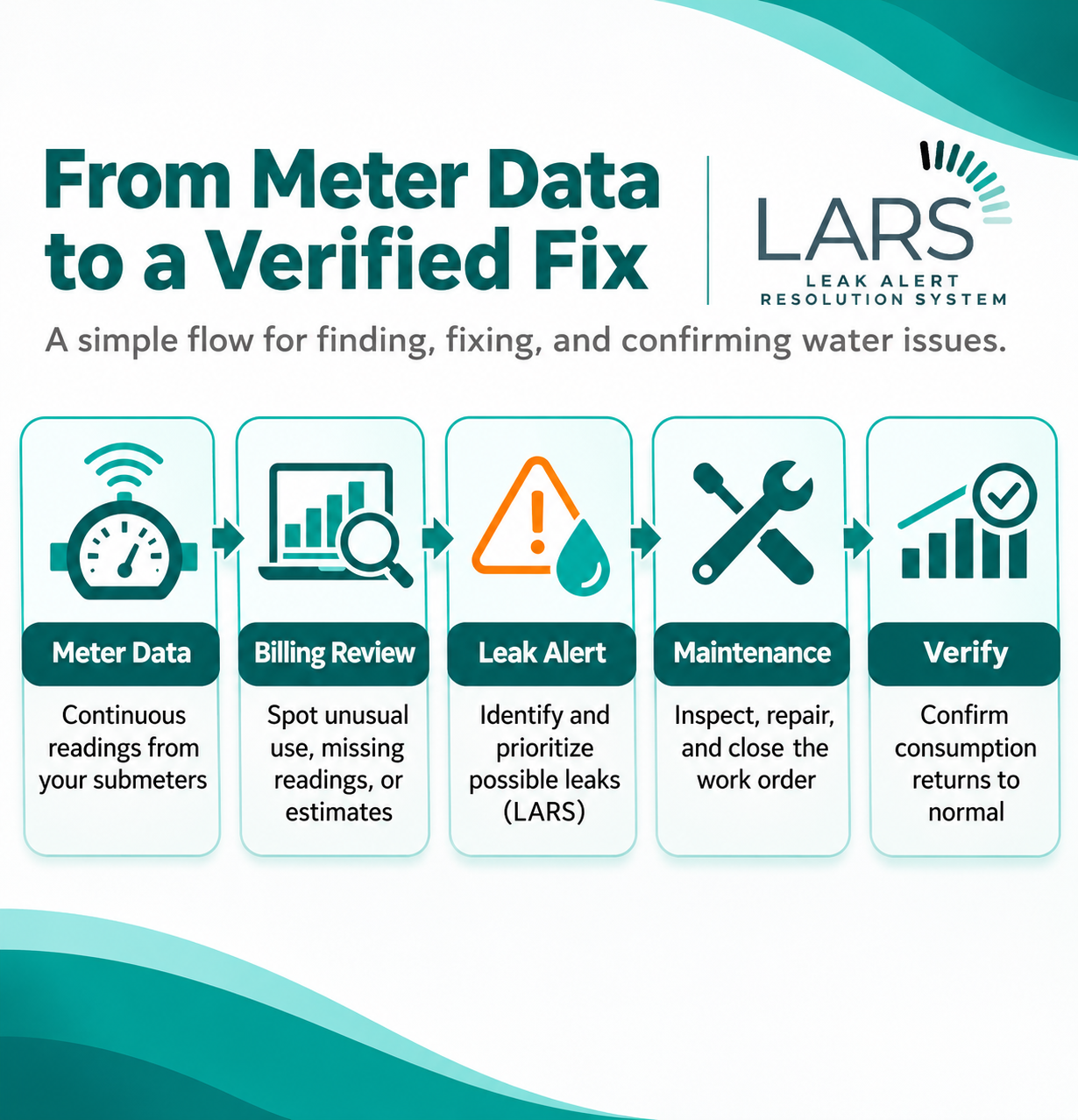
Accurate meter data helps identify problems. Maintenance and follow-up readings help confirm they're resolved.
7. Your Metering Equipment Is Getting Older—and Requiring More Attention
Water metering systems aren't maintenance-free forever. Meters, registers, transmitters, batteries, and communication equipment all have different service requirements.
Over time, a property may see more reporting interruptions, repeated battery failures, unreliable connections, or difficulty finding compatible replacement parts.
But age alone isn't a reason to replace an entire system.
A meter may still measure accurately while its transmitter needs replacing. An existing register may work with newer communication equipment. A gateway or repeater problem may explain why several units in one building stopped reporting.
On the other hand, a meter that fails an appropriate accuracy test may need replacement even if it communicates perfectly.
The key is identifying which component is actually causing the problem.
Before Replacing Your Metering Equipment, Ask:
Are the physical meters still measuring accurately?
Are the registers and transmitters compatible with newer equipment?
Are the failures isolated or widespread?
Could selective upgrades solve the problem?
Can technicians access the equipment safely for maintenance?
Sometimes the economical answer is a transmitter replacement or register upgrade. Other times, a larger modernization project makes sense.
What to check: Review equipment age, reporting history, meter accuracy where tested, compatibility, and recurring maintenance issues before approving a major replacement.
The right decision should come from the equipment's condition—not its age alone.
When Is a Variation Normal—and When Should You Investigate?
Not every unusual number requires an emergency response. But recurring exceptions deserve a closer look.
| What you notice | Possible normal explanation | Reason to investigate |
|---|---|---|
| Higher water expense | Rate or billing-period change | Actual gallons also rising without explanation |
| Master meter exceeds submeter totals | Common-area use or different read dates | Large unexplained residual after reconciliation |
| Meter stops reporting | Temporary communication interruption | Repeated stale readings without a repair plan |
| Estimated bill | Short-term data issue | Consecutive estimates without a documented cause |
| Nighttime consumption | Legitimate resident water use | Persistent flow inconsistent with prior patterns |
| Older equipment | Still functioning within specifications | Repeated failures or poor accuracy-test results |
A Property Manager's Checklist Before the Next Billing Cycle
A little review before billing can prevent a great deal of work afterward.
Use this checklist to identify problems while there's still time to investigate them.
Compare the latest master water bill with submeter consumption for matching dates.
Identify meters with missing or outdated readings.
Review accounts receiving estimated bills.
Confirm meter-to-unit assignments, especially after equipment changes.
Check unusual consumption patterns and unexplained increases.
Review outstanding resident billing complaints.
Confirm applicable utility rates and authorized charges.
Check unresolved leak alerts and repeat maintenance requests.
Verify that recently repaired leaks no longer show the same abnormal pattern.
Document exceptions that need follow-up before the next billing cycle.
You don't necessarily need new equipment to begin this review.
You need access to the right records, an understanding of how the property is configured, and a process for following up when something doesn't make sense.
A Note for South Florida Property Managers
Properties in Broward County, Miami-Dade County, Palm Beach County, and throughout Florida may operate under different utility suppliers, billing arrangements, and local requirements.
That matters when evaluating discrepancies or correcting resident charges.
For example, Miami-Dade County has specific requirements for certain water-remetering arrangements served by its Water and Sewer Department. These include rules addressing common-area consumption, billing information, estimated readings, and disputes.
Those requirements shouldn't automatically be applied to every property in Florida.
Likewise, a property's water and sewer rates depend on its utility provider, service territory, account classification, and applicable rate schedule.
Before calculating potential revenue recovery or correcting earlier resident bills, verify the rules and agreements that apply to the property.
A water discrepancy is an operational question. Whether it creates a recoverable charge is a separate billing and compliance question.
Frequently Asked Questions About Water Submeters and Utility Billing
-
Common-area water use, irrigation, vacant units, different reading dates, unmetered locations, and equipment or data problems can all contribute. Start by comparing the same measurement periods and accounting for known consumption before treating the remaining difference as unexplained.
-
Yes. In many systems, the physical meter or register continues accumulating consumption even when the communication device stops reporting. A field inspection and later cumulative reading may help establish total usage, although the exact timing of consumption may remain uncertain.
-
No. Estimates can be appropriate when actual readings are temporarily unavailable, subject to applicable rules and the billing agreement. The concern is repeated estimation without resolving the underlying issue or properly reconciling later actual readings.
-
Start by confirming the meter assignment, reading dates, consumption calculation, and applicable rates. Then compare usage history and investigate unusual flow patterns or fixture problems. Sometimes the answer requires both a billing review and a physical inspection.
-
No. Equipment condition, measurement accuracy, compatibility, maintenance history, and replacement-part availability matter more than age alone. Some properties can improve reporting through targeted upgrades while retaining serviceable meters.
-
In some cases, yes. Compatible metering systems that provide sufficiently detailed consumption data can support monitoring for unusual or continuous usage. Capabilities depend on the meter, communication system, data frequency, and monitoring platform.
The Bottom Line: Know What Your Water Data Is Telling You
Water metering problems don't always begin with a broken pipe or a failed meter.
Sometimes they begin with a reading that never arrived, an estimate that keeps getting repeated, a resident complaint that doesn't get investigated, or a maintenance repair that was never verified.
Individually, these may seem like ordinary operational issues. Together, they can reveal weaknesses in how a property measures water, manages billing, and responds to problems.
The goal isn't to assume every discrepancy represents lost revenue.
It's to understand what the numbers are telling you—and have a process for investigating what they don't explain.
Before the next billing cycle, take a closer look at the exceptions. They may be telling you more than the totals.
Need a Closer Look at Your Property's Water Billing or Metering?
If you're seeing unexplained consumption, recurring meter-reporting problems, or billing discrepancies, a utility billing and metering review can help identify where further investigation is needed.
Bring your recent utility bills, meter reports, and unresolved exceptions. A closer look at the information can help determine practical next steps.