
Before replacing your property's water meters, find out whether the meters are actually the problem.
If your water submeters still measure accurately, you may not need new meters to get better readings.
Most properties have three practical options: continue reading the existing meters by hand, retrofit compatible meters with electronic reading equipment, or replace the meters that can no longer meet the property's needs.
The right choice depends on what's installed, what manual reading actually costs, how much work an upgrade requires, and what the billing operation needs from the data.
Whether you manage an apartment community, condominium, HOA, townhome property, rental building, or commercial property, the starting point should be the same.
Identify the problem before choosing the equipment.
Start With What You Already Have
When someone says a property needs new water meters, the first question should be: Which part of the system needs replacing?
A water metering system involves several components, each doing a different job.
Meter body: Measures the water flowing through the pipe.
Register: Displays or records the meter reading.
Encoder or pulse output: Makes consumption information available electronically.
Transmitter or transceiver: Communicates meter information to a reading network.
Gateway: Collects compatible device communications and connects the property to a data platform.
Billing system: Uses the readings to calculate consumption and prepare bills.
Because these components perform different jobs, they can also fail independently.
A failed transmitter doesn't mean the meter has stopped measuring water. An outdated register doesn't automatically mean the entire meter needs replacing. And a new gateway won't correct an inaccurate measuring mechanism.
Before comparing proposals, ask a simple question:
What stays, and what changes?
Why Are Some Newer Properties Still Reading Meters by Hand?
A building doesn't have to be old to have manually read meters.
Some properties were built with mechanical meters but without the equipment needed for remote readings. Others may have compatible electronic outputs that were never connected to a communication system.
Sometimes the equipment is capable, but the property has continued using the same reading process through changes in management or billing providers.
A building's construction date won't answer those questions.
An equipment inventory will.
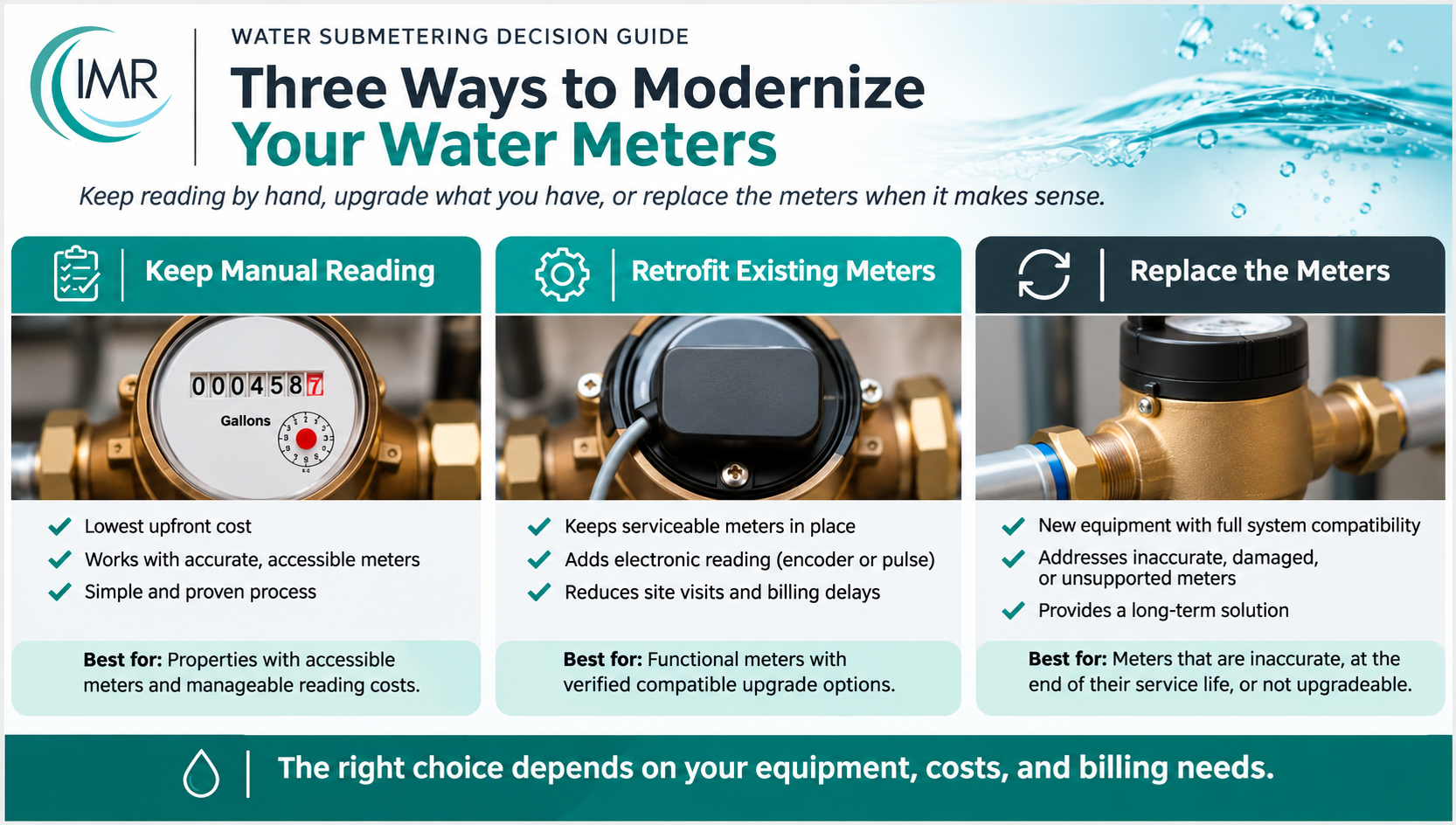
Three Options for Existing Water Submeters
OPTION 1 — KEEP MANUAL READING
Best when meters are accurate, accessible, and economical to read.
Main consideration: Include travel, repeat visits, data entry, and reading validation in the true cost.
OPTION 2 — RETROFIT EXISTING METERS
Best when the measuring equipment remains serviceable and compatible electronic upgrades are available.
Main consideration: Verify both mechanical fit and electronic compatibility.
OPTION 3 — REPLACE THE METERS
Best when meter condition, accuracy, unavailable parts, or incompatibility makes keeping the equipment impractical.
Main consideration: Account for plumbing work, water shutdowns, installation access, and testing.
Option 1: Keep Reading the Meters by Hand
Manual reading isn't automatically outdated.
Consider a small property with nine accessible water meters. If maintenance staff can collect the readings during a routine visit, the ongoing expense may be relatively low.
Now consider a community with 200 meters spread across multiple buildings, locked closets, and difficult-to-access locations.
That's a different operation.
Someone has to travel to the property, locate the meters, gain access, record each reading, enter the information, and investigate anything that looks unusual. A missed reading may mean another trip.
Even when every reading is accurate, a monthly visit tells you how much water was consumed between readings—not when that consumption occurred.
A running toilet that starts shortly after a monthly reading could continue for weeks before the next reading reveals unusual consumption.
Manual reading can still be the best option when the cost is reasonable and the property doesn't need more frequent information.
When it makes sense: The meters are accessible, the reading process is dependable, and automation would cost more than the problems it solves.
Option 2: Retrofit the Existing Water Meters
This is an option property owners should investigate before committing to full replacement.
A retrofit can preserve the equipment that measures water while upgrading how its readings are collected.
Depending on the existing meter, the work might involve connecting an available electronic output, installing a compatible encoder register, adding a transmitter, or establishing the network that carries readings to the billing platform.
The difference between an encoder and a pulse output matters.
An encoder communicates a digital representation of the meter reading.
A pulse-output device produces signals representing increments of water consumption. The reading system calculates consumption using the pulse count, the configured multiplier, and an established starting value.
If the multiplier or starting reading is incorrect, the reported consumption may also be incorrect—even when every transmission arrives successfully.
That is why installation testing matters.
A retrofit that communicates but reports the wrong consumption is not a successful upgrade.
There is also a financial consideration. Investing in new communication equipment for meter bodies that may soon require replacement could create unnecessary expense.
The condition of the existing meters needs to be part of the decision.
When it makes sense: The meter bodies are serviceable, compatible upgrades are verified, and improved reading operations justify the investment.
Option 3: Replace the Existing Water Meters
Sometimes replacement really is the right answer.
A meter may be damaged, test inaccurate, lack supported replacement components, or be unsuitable for the reading system the property needs.
But replacing the meter body is a different project from replacing its register or transmitter.
The installer must consider pipe size, meter length, connection types, flow direction, working shutoff valves, installation clearance, and accessibility.
Two meters with the same nominal pipe size may not have the same installation dimensions.
That matters when the property is occupied and the work requires shutting off water or modifying existing piping.
Replacement doesn't necessarily have to involve every meter.
A property may be able to retain serviceable, compatible meters while replacing only those that cannot reasonably be upgraded. For a broader look at existing equipment and available upgrade approaches, explore our submetering solutions.
When it makes sense: The measuring equipment itself needs attention, or keeping it would create greater long-term cost or operational problems.
Compatibility Comes Before Equipment Selection
A manufacturer's name is not a compatibility specification.
Consider two familiar names in water submetering: Badger Meter and NextCentury.
Badger Meter's HR-E encoder registers support specified Recordall meter applications. Manufacturer documentation describes register arrangements that can be serviced without interrupting water service.
NextCentury's TR4-X transceiver supports specified pulse and encoded meter interfaces. Its installation documentation describes the required configuration and meter connections.
But knowing a property has Badger meters and plans to use NextCentury equipment does not establish that the particular models will work together.
The exact meter body, register, output type, wiring, and transmitter configuration must be checked.
A field review should verify:
Meter manufacturer, body model, and size.
Register model, mounting arrangement, and measurement units.
Electronic output type and protocol.
Pulse value, where applicable.
Transmitter configuration and wire connections.
Equipment suitability for the installation environment.
Correct remote readings after installation.
There are two other details worth understanding.
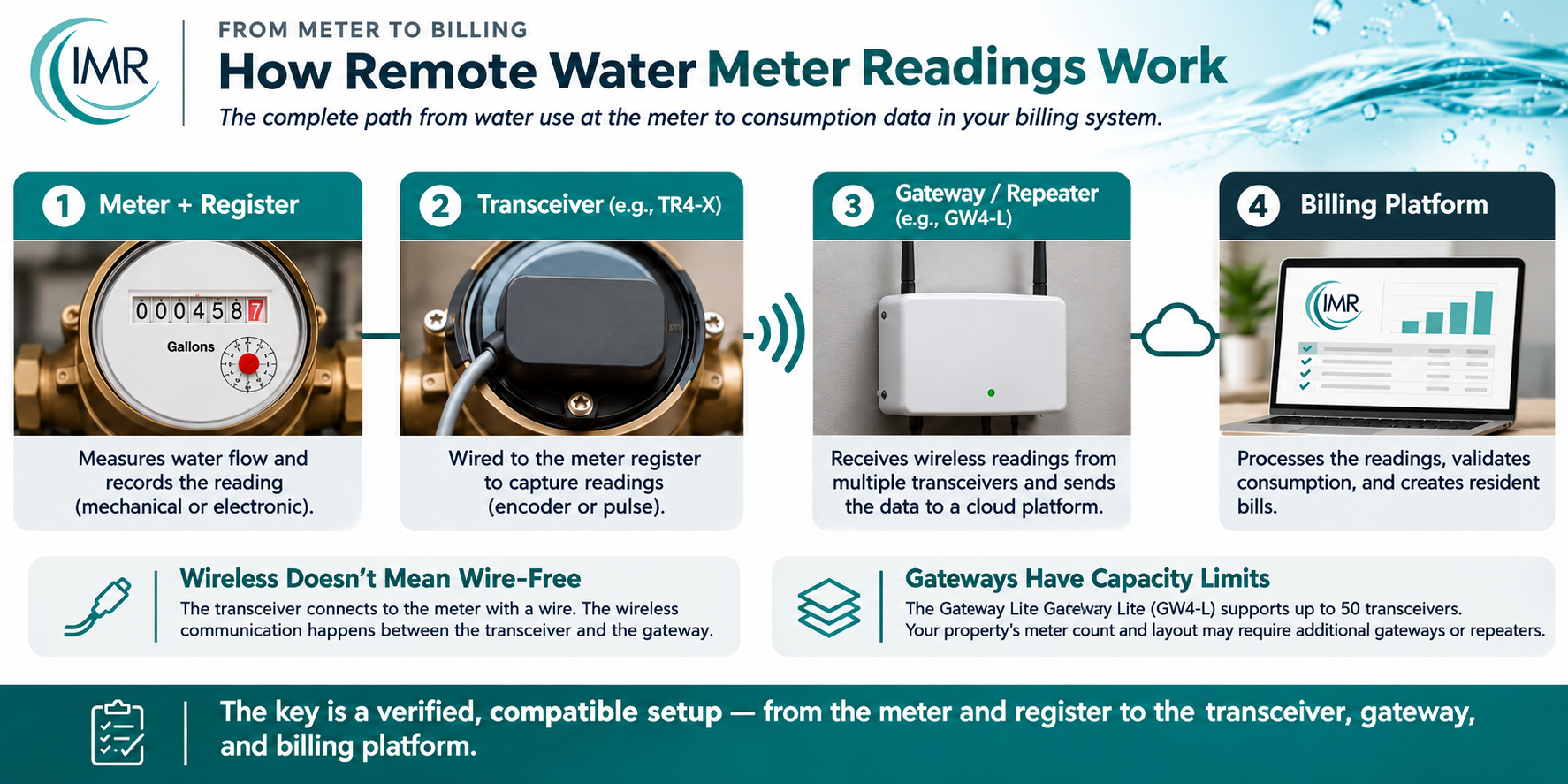
First, wireless doesn't necessarily mean wire-free.
In a system using a NextCentury TR4-X, the transceiver connects to the meter through a wire. The wireless communication occurs between the transceiver and the property's gateway or repeater network.
Second, gateways have capacity limits.
NextCentury's Gateway Lite GW4-L is specified for properties with up to 50 units. Properties with multiple meters per unit should confirm the supported device count and system configuration with NextCentury before selecting a gateway.
Gateway capacity is only one consideration. Building layout, meter locations, signal coverage, and the number of connected devices also affect network design.
The property also needs reliable communication from the actual meter locations. Concrete walls, enclosed mechanical rooms, and building layouts may require additional network planning.
If a proposal simply says wireless meter upgrade, ask for the specific equipment schedule.
What Installation Actually Involves
Picture two existing water meters.
The first has a compatible, replaceable register that can be upgraded without disturbing the plumbing.
The second sits tightly between pipes, with limited clearance, an aging shutoff valve, and no compatible electronic output.
Both may appear on an estimate as a "meter upgrade."
They are very different jobs.
A proper field assessment should determine whether the existing register can be accessed and removed, whether the replacement equipment fits, where the transmitter will mount, and whether its connections can be protected from the surrounding environment.
If plumbing work is necessary, the installer must also evaluate the shutoffs, pipe configuration, and any required water interruption.
And if residents need to provide access or receive notice, those arrangements belong in the installation plan—not as an afterthought.
The final step is testing.
Before completing a full rollout, representative installations should be tested from the meter all the way through the billing system.
Testing should also confirm reliable wireless communication between transmitters and gateways, particularly in mechanical rooms, enclosed spaces, and buildings with concrete walls.
The remote reading must correspond to the correct meter, use the right measurement units, belong to the correct unit, and reach the billing platform accurately.
A device appearing online is not the same as a completed, verified installation.
Compare Five-Year Cost, Not Just Equipment Prices
The price of a new water meter compared with the price of a retrofit kit is only part of the financial picture.
Metering costs should also be evaluated alongside the property's ability to recover eligible utility expenses. Our guide to multifamily water loss and revenue recovery explains why equipment problems and billing losses require different solutions.
A meaningful comparison also includes installation, plumbing modifications, manual-reading labor, gateway equipment, connectivity, hosting, maintenance, and the time required to review the data.
Small properties should pay particular attention to subscription minimums.
For example, NextCentury's published subscription guidance has listed hosting at $0.30 per unit monthly, subject to a $25 monthly minimum, with separate cellular charges. Pricing and service terms should be confirmed before making a purchasing decision.
IMR Billing Services | Cost Comparison
What Does Each Option Cost Over 5 Years?
Illustrative water submeter ownership costs by property size

| Meters | Manual | Retrofit | Replace |
|---|---|---|---|
| 9 | $3,285 | $8,525 | $10,235 |
| 50 | $11,075 | $19,800 | $29,300 |
| 200 | $39,575 | $63,150 | $101,150 |
Manual reading has the lowest modeled five-year cash cost in all three scenarios. Remote reading may still justify its investment through fewer access problems, more reliable billing data, and earlier identification of unusual consumption.
Water meter retrofit vs. replacement: five-year cost comparison. Hypothetical ownership costs for properties with 9, 50, and 200 water submeters, comparing manual meter reading, electronic meter retrofits, and full meter replacement. Figures are illustrative, not IMR quotations or guaranteed savings. The 200-meter network allowance requires additional engineering and pricing. Assumptions and exclusions are explained in the article.
What Do These Numbers Tell Us?
Under these assumptions, manual reading has the lowest five-year cost for all three property sizes.
That may surprise property owners who assume automation always saves money.
But the purpose of an upgrade isn't simply to eliminate a monthly walk around the property.
The more useful question is whether the upgrade provides enough additional value to justify its cost.
In this example, the retrofit's five-year cost exceeds manual reading by approximately:
$1,048 per year for a nine-meter property.
$1,745 per year for a 50-meter property.
$4,715 per year for a 200-meter property.
These are average annual cost differences over the modeled five-year period, not guaranteed savings or complete payback forecasts.
They also do not account for potential benefits such as avoiding repeated access visits, reducing costly billing exceptions, or identifying unusual water consumption sooner.
Those benefits need to be evaluated using the property's actual circumstances. Potential leak savings, in particular, should not be treated as guaranteed.
And remember: freeing up staff time doesn't automatically produce the same amount in cash savings.
The goal isn't to prove that automation saves money. It's to determine whether the investment solves enough real problems to justify its full cost.
How We Calculated the Five-Year Costs
These figures are illustrative estimates designed to help property owners compare their options—not actual project quotations or guaranteed savings.
The model uses the following assumptions:
Manual reading: $35 per labor hour, including 45 minutes of shared travel and setup per visit, plus four minutes per meter, with readings collected monthly.
Retrofit: An illustrative installed cost of $235 per meter.
Replacement: An illustrative installed cost of $425 per meter.
Network equipment: A $2,000 shared allowance, used as a simplified modeling assumption rather than a verified network design.
Ongoing expenses: Modeled hosting, cellular connectivity, maintenance, and data-review labor over five years.
The comparison excludes financing, taxes, major plumbing modifications, and potential water savings. It also assumes the existing meter bodies remain serviceable throughout the five-year period.
For a 200-meter property, the network would require additional engineering and potentially multiple gateways or repeaters. The $2,000 allowance should not be interpreted as a realistic quotation for that installation.
Every property should compare actual supplier quotations, site conditions, and operating costs before making an investment decision.
A Meter Upgrade Is Also a Billing Decision
Meter readings become consumption records. Consumption records become bills.
An equipment upgrade isn't finished simply because the devices are communicating.
The readings must be accurate, correctly assigned, and usable by the billing system.
Before and after installation, the property should document the final old readings, initial new readings, meter and transmitter serial numbers, unit assignments, measurement units, and applicable multipliers.
There should also be a clear process for missing or incorrect readings.
Our guide to How Multifamily Utility Billing Works explains what happens to meter information after it's collected.
One more question belongs in every proposal:
Who owns the equipment, controls the platform account, and has access to the historical reading data?
That becomes especially important when a property changes billing providers.
A property shouldn't discover during a transition that it cannot retrieve its own meter information.
For more on that process, see How to Switch Utility Billing Companies Without Disrupting Residents.
What More Frequent Readings Can Tell You
Monthly meter readings tell a property how much water was used.
More frequent readings may help show when that consumption occurred.
That difference can be valuable.
An unusual overnight consumption pattern, continuous water use, or unexpected activity in a vacant unit may deserve investigation.
But the usefulness of that information depends on the meter's resolution, the frequency of collected readings, reliable transmission, and the software reviewing the data.
More readings alone don't identify a leak.
A transmitter doesn't diagnose a plumbing problem, and an alert doesn't repair one.
Useful monitoring requires dependable data, analysis, notifications, and someone responsible for investigating the condition.
That's the thinking behind IMR's Leak Alert Resolution System (LARS): using compatible meter data to identify and prioritize unusual consumption so property teams know what deserves attention.
If leak monitoring is part of the reason for upgrading, confirm before purchasing that the equipment will provide the information the monitoring system requires.
South Florida Water Metering Considerations
Water metering projects can involve more than equipment selection.
Requirements differ by county, municipality, and property type. A condominium in Miami-Dade County may face different obligations from an apartment community in Broward County or a commercial property in Palm Beach County.
For property managers in Broward County, including Sunrise, Fort Lauderdale, Hollywood, and Pembroke Pines, evaluating an existing water submetering system often begins with meter accessibility, equipment compatibility, and the cost of collecting readings. In Miami-Dade County, properties in Miami, Doral, Hialeah, and surrounding communities may face similar technical challenges, along with specific water-remetering requirements where applicable. Palm Beach County properties should also evaluate their local requirements and existing billing procedures before making equipment changes.
Across South Florida, the best approach starts with understanding the property's actual equipment and operational needs—not assuming every meter requires replacement.
For example, properties covered by Miami-Dade County's water-remetering program must follow applicable requirements for registration, billing disclosures, meter testing, and recordkeeping.
County guidance includes a 12-month retention period for specified meter-reading and billing records.
That makes data access important. If a metering platform provides only six months of accessible historical readings, a covered property may need a separate export and archive process to satisfy its obligations.
Access procedures also matter.
Florida law addresses notice and reasonable entry hours for certain residential rental repairs. Condominium associations and HOAs may operate under different statutory provisions and governing documents.
When plumbing modifications are involved, the property should also confirm permit requirements with the appropriate local building department.
The takeaway: A water meter upgrade should account for local requirements, resident access, record retention, and billing procedures—not just equipment compatibility.
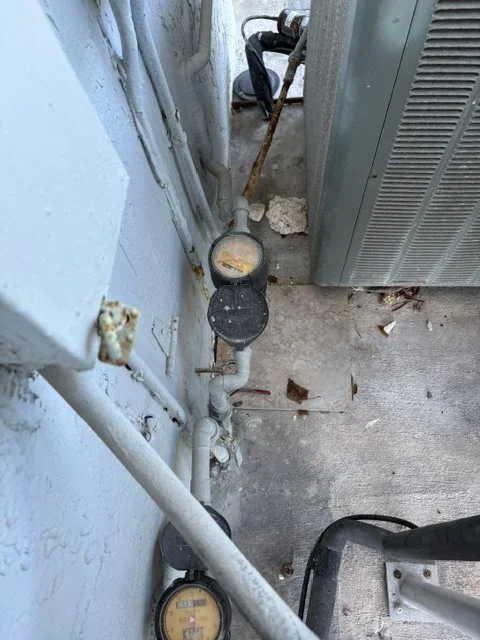
Existing outdoor water meters illustrate why access, pipe configuration, and available clearance should be evaluated before choosing a retrofit or replacement.
Before You Request a Quote: A Property Manager's Checklist
Before committing to a water meter retrofit or replacement project, make sure you can answer these questions:
What manufacturer, model, and size are the existing meters?
What registers and electronic outputs are installed?
Are the existing meter bodies accurate and serviceable?
Has compatibility with the proposed transmitters been verified?
What does manual reading actually cost, including repeat visits?
Is there enough clearance for the proposed equipment?
Are plumbing modifications or water shutdowns necessary?
Does the proposed gateway network have adequate capacity and coverage?
How will the readings reach the billing platform?
Who owns the equipment and controls access to the data?
What are the upfront and recurring costs over five years?
How will the completed installation be tested?
A qualified assessment of the existing equipment can prevent unnecessary replacements, unexpected installation costs, and billing problems after the upgrade.
Frequently Asked Questions About Water Meter Retrofits
-
Some can. Existing meters may support compatible electronic registers or communication equipment, but the exact meter body, register, output type, and transmitter must be verified before selecting a retrofit.
-
No. The meter body measures water consumption, while the register records or displays the reading. A compatible register upgrade may leave the meter body in place.
-
Not always. Some supported register upgrades can be performed without interrupting service. Replacing a meter body or modifying plumbing requires an appropriate isolation and shutdown plan.
-
No. A transmitter communicates meter readings. It doesn't correct inaccuracies in the measuring mechanism. Meter accuracy must be evaluated separately.
-
It depends. Manual reading may be more economical when meters are accessible and the process is efficient. Automation may offer greater value when access is difficult, repeated visits are costly, or more frequent data supports important operational needs.
-
Automated systems can supply consumption data that supports leak monitoring. Identifying possible leaks also requires suitable data frequency, reliable communications, analysis, and a response process.
-
Retention varies by platform and service arrangement. Properties should confirm how much history remains accessible and whether regular exports or independent archives are needed for billing, operational, or regulatory purposes.
The Best Upgrade May Be the One You Don't Need
Sometimes the answer is a new water meter.
Sometimes it's a compatible register, transmitter, or communication system.
And sometimes it's simply a better process for collecting and validating the readings already available.
The important thing is knowing the difference.
At IMR Billing Services, we work with property owners and managers across Broward, Miami-Dade, and Palm Beach counties to evaluate water submetering, meter reading, and utility billing needs.
If you're considering an upgrade, start with a review of your existing water submetering system to determine what can stay, what needs attention, and whether an upgrade makes sense.
Before you replace the meters, make sure you've found the problem.
Before You Replace Your Water Meters, Understand Your Options
Not every property needs a complete meter replacement. Some existing systems can be upgraded with compatible registers and transmitters, while others require new meters, plumbing modifications, or additional communication equipment.
The right decision starts with understanding what is already installed, what can be reused, and what it will take to deliver reliable readings.
Not sure whether your existing meters can support remote reading?
IMR Billing Services helps property owners and managers evaluate existing metering systems, identify practical upgrade options, and plan for accurate, dependable utility billing.