
Multifamily Water Loss and Revenue Recovery: Where to Look First
The property's water bill keeps climbing. The meters appear to be working. Residents are receiving their utility bills. Yet water expenses keep outpacing what the property recovers.
Where is the money going?
It isn't always a hidden leak. The cause may be excessive consumption, a meter that stopped reporting, an account that wasn't billed, an incorrect rate, or charges that were issued but never paid.
Water loss and utility revenue loss are different problems, and they need different fixes. Knowing which one you have is the first step toward reducing avoidable expense and protecting operating income.
Are you losing water, missing charges, or waiting on payments?
When a water bill rises, most people assume a plumbing leak. That may be true. But a rising bill can also expose weaknesses in how consumption is measured, billed, or collected.
These problems can appear together, but they aren't interchangeable. A running toilet creates avoidable expense even when its consumption is measured and billed correctly. An unbilled apartment creates a revenue gap without wasting a gallon. An unpaid balance hurts cash flow even when the meter and the bill are both right.
So the first question isn't "Where is the leak?" It's "What kind of problem are we dealing with?"
Follow the water, then follow the money
A useful review runs two separate investigations.
Follow the water. At a submetered community, the utility's master meter records what's delivered to the property, and submeters record what each unit uses. The difference between them is a place to start, not proof of a leak. Common areas, irrigation, missing reads, and mismatched reading periods can all explain it. Before calling a gap "water loss," confirm the readings cover the same dates, use the same units, and account for known uses outside the apartments. Our guide to how meter readings become resident charges walks through that reconciliation in detail.
Follow the money. Four figures tell the financial story:
Utility expense → Eligible resident charges → Charges actually billed → Payments collected
Utility expense: what the water and sewer provider charged the property.
Eligible resident charges: what can properly be billed under the property's billing method, agreements, and applicable rules.
Charges billed: whether those amounts were calculated and issued correctly.
Payments collected: how much was actually received.
An eligible charge that never reaches a bill is a billing gap. A valid charge that stays unpaid is a collection gap. Water used in a common area may simply be a legitimate property expense.
Keep the two investigations separate. Gallons and dollars answer different questions, and mixing them leads to the wrong fix.
Recovering more revenue doesn't mean charging residents for every gallon on the master bill. It means billing eligible charges accurately and managing the costs that remain the property's responsibility.
1. Small leaks that run between billing cycles. A running toilet or a valve that won't seat fully rarely looks like an emergency, but it can run for weeks. If the property only sees monthly reports, nobody notices until the next bill. The EPA's WaterSense program describes how frequent meter data and continuous-use reports help facility managers spot conditions worth investigating. See how quickly small leaks add up.
2. Meters that stop reporting or report incorrectly. A meter can stay installed while its data goes missing. A transmitter stops communicating, a register needs attention, or a meter is tied to the wrong unit. Reliable billing needs usable readings, accurate account records, and a process for exceptions.
3. Vacant units with unexpected consumption. A unit marked vacant may still register use. Turnover work, cleaning, or a wrong occupancy or meter assignment could explain it, and so could a leak. Find out what happened before assigning cost or responsibility.
4. Eligible charges that never reach a bill. The water was measured correctly, but the billing process missed it: wrong move-in or move-out dates, missing account data, a misconfigured rate, or readings that weren't processed. These are hard to see when reports are reviewed only for total dollars instead of account-level exceptions.
5. Unpaid balances. A charge on a resident's bill isn't a payment received. Collections belong in any complete recovery review, because accurate meters and accurate bills don't help cash flow if the money never arrives.
What can abnormal consumption cost?
Consider a fictional 200-unit community where ten separate plumbing conditions each waste an average of 10 gallons per hour. That's 2,400 extra gallons a day and 72,000 gallons over 30 days.
If all ten were investigated and repaired after three days instead of thirty, the property would avoid 64,800 gallons of consumption.
This is an illustrative calculation, not an IMR customer result or a LARS performance claim. The dollar impact depends on the serving utility, the account's rate class, usage tiers, and other bill components. And an earlier alert only helps if someone investigates and the repair actually gets done.
Now add a separate financial problem at the same property:
Eligible resident charges: $10,000
Charges actually billed: $9,500
Payments collected on those bills: $9,000
Here, $500 of eligible charges were never billed and $500 of billed charges remain unpaid. The unpaid amount may still be collected, and whether an omitted charge can be corrected depends on the applicable rules. The wasted water is a third, separate issue.
The goal is to reduce avoidable consumption and tighten billing and collections, without counting the same dollars twice.
What should you investigate when the water bill rises?
A structured review beats assuming a plumbing failure. Each item below names the team that usually owns it.
Match the billing periods. Master-meter, submeter, and billing dates should align. (Billing)
Verify the rate and account class. Confirm the property is billed under the right schedule. (Billing)
Review missing or estimated reads. Find units with incomplete data. (Billing / meter support)
Confirm meter-to-unit assignments. Each meter should map to the right account. (Meter support)
Check vacant units and recent move-outs. Look for unexpected use and responsibility errors. (Management)
Account for common-area use. Include irrigation, amenities, and other known uses. (Management)
Investigate abnormal consumption. Have maintenance inspect credible signs of leaks. (Maintenance)
Compare eligible, billed, and collected amounts. Separate billing errors from collection issues. (Billing / management)
Verify the outcome. After a fix, check later data to confirm the problem stopped. (Everyone)
Assigning each problem to the right team prevents repeat investigations and expenses that never get resolved. If you'd like a second set of eyes on these numbers, IMR offers a free utility billing review.
Can your existing submeters warn you sooner?
Many properties already have water submeters with automated reading. The question is whether that system delivers useful data between billing cycles.
Compatible systems can reveal patterns like water use that continues overnight, sudden increases against a unit's history, consumption that persists after a repair, and readings that are missing or inconsistent.
A reading alone doesn't establish the cause. Continuous flow can be a leak or legitimate use, and monitoring can flag unusual consumption without pinpointing the fixture. How useful the data is depends on meter compatibility, reading resolution, communication reliability, and authorized access to the system. For more, see what continuous-flow patterns can and cannot tell you.
Where LARS fits
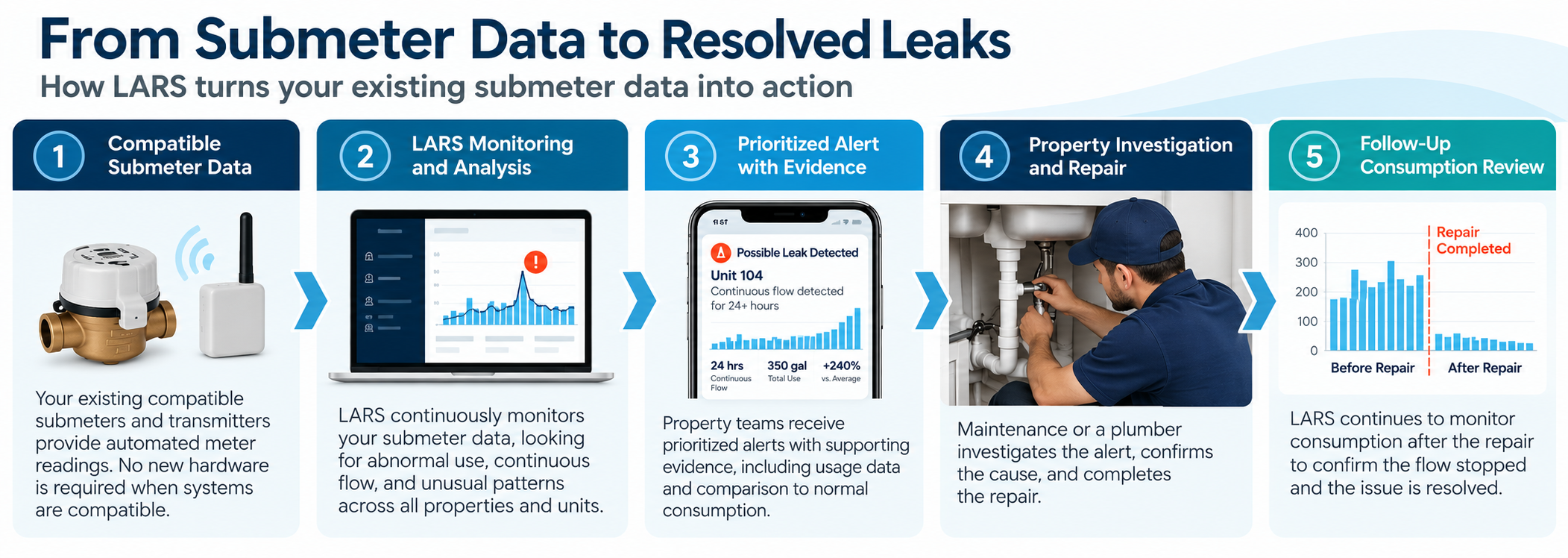
LARS (Leak Alert Resolution System), offered by IMR Billing Services, puts compatible existing submeter data to work. It monitors available consumption data, identifies potential abnormal-use conditions, and sends prioritized alerts with supporting evidence, so property teams can investigate before the next monthly bill.
LARS doesn't physically locate or repair leaks. It points the right people at conditions that deserve attention. After an alert, the team reviews the evidence, decides whether the use is legitimate, sends maintenance or a plumber when needed, and checks later data to confirm the flow stopped. Our article on moving from leak alert to verified resolution covers that process.
Why South Florida properties need a property-specific review
In Broward, Miami-Dade, and Palm Beach counties, water costs and billing rules vary by property. Location alone doesn't determine the rates or what can be billed to residents. The serving utility, account class, property type, and agreements all matter.
Miami-Dade County, for example, has water remetering requirements for covered properties. They address how residents are billed, who pays for common-area water, and limits on certain added charges. Florida law also has provisions for qualifying utility resale arrangements, but they aren't blanket permission to add fees or pass through every water expense.
A rate quoted for one utility or customer class may not reflect another property's master account. A useful review starts from the actual property, not a generic formula.
How IMR connects billing, meters, and monitoring
Utility performance depends on connected work: reliable meter data, the right billing method, accurate resident accounts, working equipment, and a response to unusual consumption. IMR's services cover those pieces from different angles:
Utility billing and revenue recovery reviews eligible charges, billing accuracy, account data, and collection gaps.
Submetering and field support handles the equipment and meter-data issues that affect measurement and billing.
LARS leak monitoring flags potential abnormal consumption where compatible meter data is available.
For South Florida communities, a local team that handles billing, submetering, and field work makes that coordination practical.
Frequently asked questions
-
A difference between a multifamily property's master water meter and the combined apartment submeter readings does not automatically indicate a water leak. Common-area water consumption, irrigation, missing meter readings, meter inaccuracies, and differences in reading dates can all contribute. Property managers should compare matching billing periods, verify meter data, and account for shared water use before determining whether the discrepancy represents water loss.
-
A multifamily property may not recover its full water and sewer expenses because some consumption is the owner's responsibility, eligible charges are missed, billing calculations are incorrect, or resident balances remain unpaid. Utility revenue recovery begins by comparing the property's actual utility expenses with eligible resident charges, bills issued, and payments collected. Not every property expense can legally or contractually be passed through to residents.
-
Some existing automated water submetering systems can provide consumption data that helps identify possible leaks, continuous water flow, and abnormal usage without installing a separate leak-detection sensor network. IMR Billing Services' LARS (Leak Alert Resolution System) uses compatible submeter data to identify conditions that warrant investigation. Compatibility, available data, and communication reliability must be evaluated first. LARS provides monitoring and alerts; maintenance personnel or qualified plumbers investigate and repair confirmed leaks.
-
Whether a Florida multifamily property can bill residents for water consumed through a plumbing leak depends on the property's billing arrangement, lease terms, applicable state and local requirements, and the circumstances of the leak. Rules may differ between properties in Broward, Miami-Dade, and Palm Beach counties. Property owners should verify which charges are permitted rather than assuming all water recorded by a submeter can automatically be billed to a resident.
-
When a water submeter indicates continuous flow or abnormal consumption, property management should review the available meter data, confirm the correct apartment or equipment assignment, and determine whether the usage may be legitimate. If a leak is suspected, maintenance or a qualified plumber should investigate and make necessary repairs. Afterward, the property should review subsequent consumption readings to determine whether the abnormal water use has stopped.
-
A multifamily property can improve utility revenue recovery by identifying missed eligible charges, correcting meter-to-unit assignments, reviewing move-in and move-out records, resolving missing meter readings, and improving billing and collection procedures. These improvements focus on accurate billing rather than raising resident rates. IMR Billing Services provides utility billing, submetering support, and revenue recovery services for multifamily communities throughout South Florida.
Start with a clearer picture of your utility expenses
A higher water bill doesn't always mean a leak. A gap between utility expense and resident payments can come from consumption, billing, or collections, and each needs a different fix.
IMR Billing Services helps South Florida owners and managers find out where the problem starts and what will actually address it.
Serving multifamily properties and communities throughout Broward, Miami-Dade, and Palm Beach counties.