
Water Submetering vs. Leak Detection: What Property Owners Should Know
Your building has water meters. Residents receive monthly utility bills. The readings are being collected, and everything appears to be working.
But suppose a toilet starts leaking at 2 a.m.
Who knows about it?
Does anyone receive an alert? Does someone review the consumption data? Or does the problem continue until a resident notices something, maintenance stumbles across it, or the next water bill arrives?
These questions matter because having water meters and actively monitoring water consumption are not the same thing. A property can have accurate submeters and a dependable billing process and still have very little visibility into what happens between billing cycles.
The issue usually isn't the meter. It's what happens—or doesn't happen—after the meter records the water.
This article walks through six questions any owner can ask about an existing system:
1. What does each meter actually measure?
2. How much detail is kept—monthly totals, daily readings, or hourly history?
3. How quickly does that information reach anyone?
4. Does anyone, or any software, review it for unusual patterns?
5. Who is responsible for acting on a finding?
6. What evidence shows the problem was actually fixed?
The answers will tell you more about your property's water management than the number of meters installed.
What Your Water Meters Are Actually Telling You
A water submeter measures the volume of water passing through a particular plumbing connection. In apartment buildings and condominiums, submeters typically measure consumption for individual units.
The property's master meter generally measures the water supplied through the utility connection. Each submeter measures only the portion of that supply flowing through its own connection. Plumbing that bypasses a submeter—shared laundry, irrigation, a pool, a separately supplied water heater—isn't captured by it. So the first question is always coverage: what does this meter actually measure?
Within that coverage, the meter simply counts water. It doesn't know whether the water went toward a shower, a dishwasher, a running toilet, or a broken supply line.
How the readings are collected depends on the equipment. Some properties still rely on someone physically reading each meter. Others use electronic registers, wireless transmitters, and remote-reading systems. Depending on the setup, a property may receive a monthly total, daily readings, hourly consumption history, or something more detailed.
Each arrangement provides a different level of visibility. Accurate measurement does not automatically mean anyone is monitoring consumption.
The U.S. Environmental Protection Agency's WaterSense at Work guidance makes the same distinction. Conventional meter data can help staff identify long-term trends and anomalies, including sizeable leaks—but because conventional readings are typically collected monthly or quarterly for billing, it is harder for owners to monitor use and respond quickly. Where data isn't centralized, EPA recommends assigning someone responsibility for tracking water use at least monthly and investigating unexpected deviations.
In other words, even a basic system can support oversight—if someone owns the job.
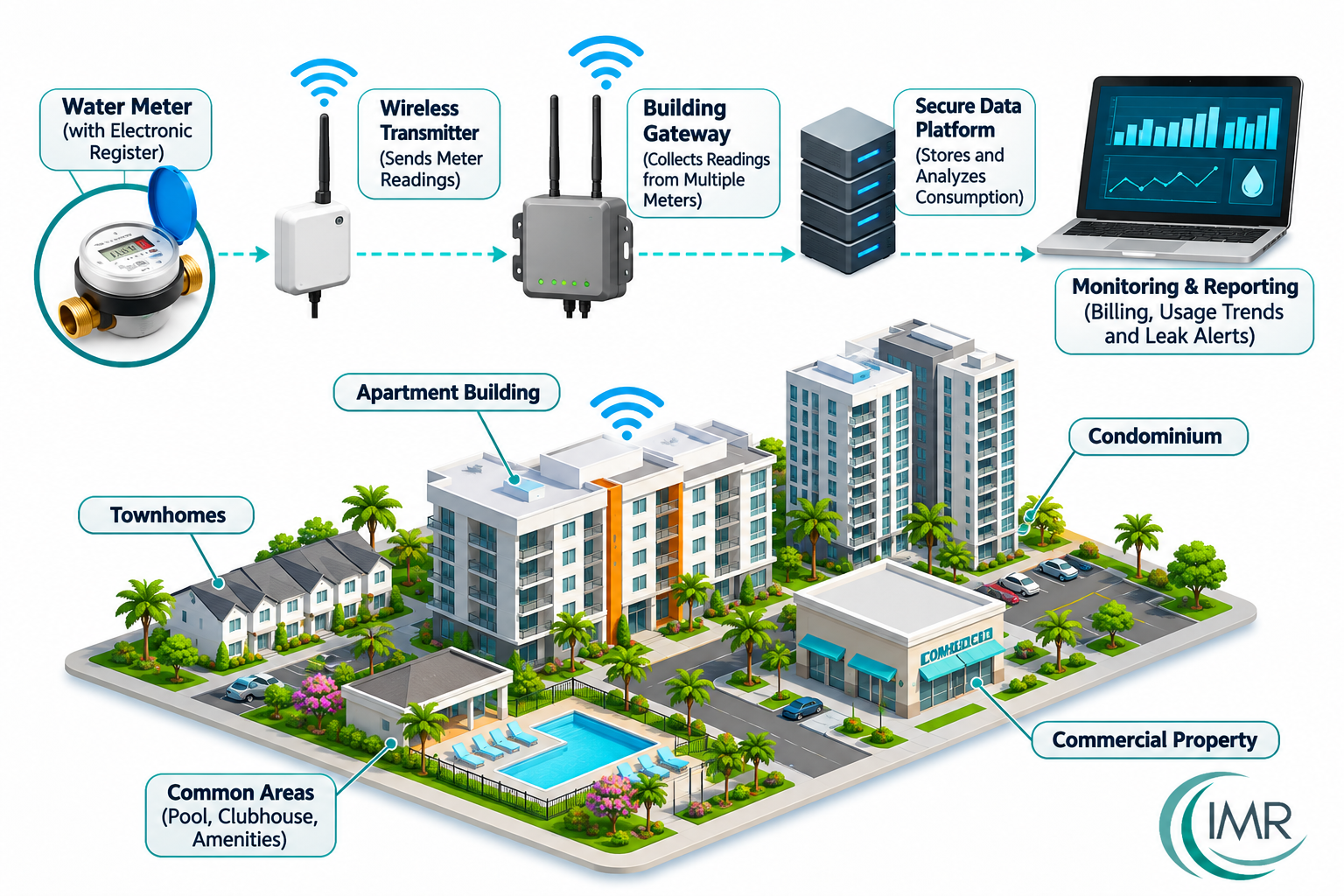
A compatible remote-reading system may retain the existing meter body while upgrading reading and communications components. The detail available depends on the equipment and its configuration.
Billing and Leak Monitoring Answer Different Questions
Utility billing and leak monitoring often start with the same meter readings. Their objectives are different.
Billing is concerned with calculating and administering the appropriate charges. Monitoring asks whether a consumption pattern suggests a condition that deserves investigation.
| Utility Billing Asks… | Consumption Monitoring Asks… |
|---|---|
| How much water was used? | When was it used? |
| Which unit should be billed? | Does the pattern look unusual for this unit? |
| Are the readings accurate and complete? | Has consumption changed unexpectedly? |
| Was the resident bill issued? | Was the potential problem investigated? |
| Was the billing cycle completed? | Did later readings show the problem stopped? |
These services aren't mutually exclusive. Some billing providers and metering platforms include usage alerts or monitoring; others offer them separately, or only under certain service arrangements.
So the question for an owner isn't whether a billing company can monitor consumption. It's whether someone is monitoring it under your current arrangement, how often, and what happens when something unusual appears.
Monthly readings still have real value. A month-over-month jump can reveal that a unit used far more water than usual, and that can lead to finding a leak. What a monthly total generally can't tell you is when the extra water was used—whether it happened in one afternoon or seeped away every night for three weeks.
That is where more detailed meter data becomes useful.
How Much Detail Reaches You—and How Late?
Monthly totals versus interval history
Consider two buildings.
Building A has individual submeters read manually once a month. Management compares each unit's total with previous periods.
Building B has compatible remote-reading equipment that records hourly consumption history and periodically sends it to a data platform.
Both can produce accurate monthly bills. But Building B potentially offers something more: someone can see when water was used, whether consumption occurred repeatedly during overnight hours, and whether an unusual pattern continued for several days.
The EPA's WaterSense program notes that frequent, hourly AMI data can help facility managers identify leaks before the bill arrives and better understand consumption patterns.
That still doesn't mean Building B has effective leak detection.
Recording frequency is not notification speed
"Hourly data" can describe several different things. It's worth asking about each link in the chain separately:
• How often is consumption recorded? (The interval of the history.)
• How much history is retained?
• How often does the transmitter send readings?
• How often does the gateway or network deliver them to the platform?
• How often does anyone—or any software—evaluate them?
• When does an accountable person actually receive a useful notification?
These aren't necessarily the same. A device can retain hourly readings and transmit them in batches several times a day. The information is still valuable, but it shouldn't be described as "real-time" just because hourly history exists. Hourly data reviewed once a week is, in practice, a weekly process.
Missing data is not zero use
If a transmitter stops communicating, the absence of new readings doesn't mean the apartment stopped using water. The meter may still be measuring consumption that isn't reaching the platform. A gap should be treated as "data unavailable," not as zero consumption—and never as evidence that a problem was resolved.
We cover this in more detail in our guide to why apartment water meters stop reporting.
What an Unusual Consumption Pattern Can Suggest
Imagine reviewing an apartment's hourly history.
On a typical night, use is intermittent. Someone uses the bathroom, a fixture runs briefly, and consumption drops to little or nothing during the quietest hours.
Then the pattern changes. Instead of several hours with little or no recorded use, the meter begins registering consumption in every overnight interval, night after night.
That deserves attention. It might indicate a running toilet—a worn flapper or faulty fill valve can cause a toilet to refill repeatedly without any visible water on the floor. The EPA lists worn toilet flappers among the most common household leaks and notes that a bad flapper can silently waste thousands of gallons a year.
But the same pattern could also reflect legitimate activity: a resident working nights, an appliance running on a schedule, a new occupant, or a data problem such as a meter assigned to the wrong unit.
An unusual consumption pattern is a reason to investigate—not proof of a leak.
Hourly totals also have limits. If a meter records six gallons in each of six consecutive hours, that doesn't prove water flowed continuously every second. The same totals could come from steady low flow, repeated refill cycles, or separate ordinary uses within each hour. The accurate statement is "consumption was recorded in every hourly interval," not "the water never stopped."
The reverse is also true: an hour showing zero doesn't absolutely prove no water moved. Very small flows can fall below what a particular meter or register reports.
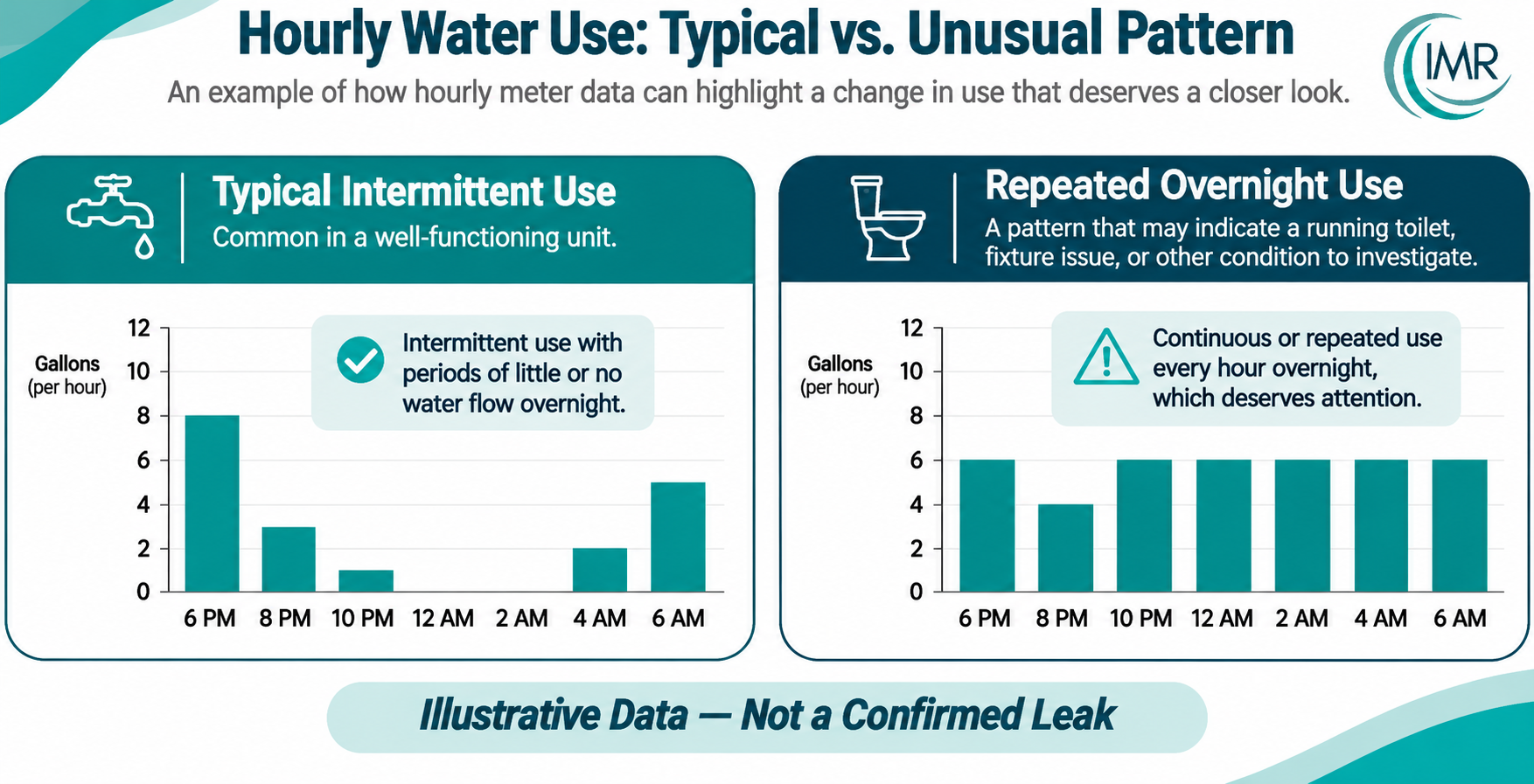
Hypothetical data. Repeated overnight consumption may warrant investigation, but nonzero hourly totals don't establish continuous flow or a confirmed leak.
The most useful monitoring looks beyond a single high reading. It weighs how long a pattern has persisted, when it occurs, how it compares with the unit's own history, and whether the underlying data is complete and correctly assigned.
For a deeper explanation, see what continuous water-use patterns can—and cannot—show.
An Alert Is Where the Work Starts
Suppose the system flags abnormal consumption in an apartment. Now what?
A notification may go to the property manager. Maintenance may get an email. The resident may be asked to check toilets and faucets.
But an alert doesn't repair anything. Someone still has to decide whether the condition is real, find the cause, arrange access, and complete the repair. At this point, water monitoring becomes an operational process rather than a technology feature.
A practical approach follows six stages:
Identify → Prioritize → Notify → Investigate → Repair → Verify
From Alert to Verified Resolution
Six connected stages that turn unusual water consumption into a documented outcome.
Identify
Validated readings showing what looks abnormal, for which meter, and over what period.
Prioritize
Assess urgency using likely volume, duration, damage risk, data confidence, and access.
Notify
Reach a named person with a clear next step and an escalation path.
Investigate
Document whether the cause is a confirmed fault, legitimate use, data issue, or remains unexplained.
Repair
Record what was fixed, where, when, and by whom.
Verify
Review later valid readings to determine whether the abnormal pattern stopped and document the outcome.
Why Repair Verification Matters
Imagine maintenance finds a running toilet, replaces the flapper, and closes the work order.
The repair may have solved the problem. But what if the fill valve is also malfunctioning? What if the toilet starts running again the following day? Or what if the original abnormal consumption came from something else entirely?
Closing a work order tells us that someone completed a task. It doesn't necessarily tell us whether the unusual water consumption stopped.
When reliable interval data is available, reviewing consumption after the repair can help answer that question. Did the overnight pattern return to its previous behavior? Are there now periods with little or no recorded consumption? Is the meter still reporting properly?
Verification doesn't require every unit to have zero overnight usage. Residents have different schedules, and legitimate consumption can occur at any hour. The goal is to determine whether the specific abnormal pattern that prompted the investigation has changed.
This is why we believe water management should be measured by more than the number of alerts generated or work orders closed. A more useful operational question is: How long did it take to identify, investigate, repair, and verify the problem?
We think of that as time to verified resolution. It's a practical way to evaluate the entire response process, not just the monitoring software.
For a closer look at the process, read our guide to multifamily leak detection and resolution, including why finding a potential leak is only the first step toward fixing it.
What About Smaller Buildings and Older Meter Systems?
It's easy to assume that detailed water monitoring is something only large apartment communities can afford or manage. But smaller buildings may have just as much reason to pay attention to unexplained consumption.
Consider a nine-unit apartment building with manually read water meters. Each meter may be working perfectly well, and the owner may have no problem collecting monthly readings. Yet if a toilet starts running shortly after the monthly read, the problem could continue for weeks before anyone notices the increased consumption.
Moving to remote readings may improve visibility, but the right approach depends on the equipment already installed.
Some existing meters can be upgraded with compatible electronic registers, transmitters, and communication equipment. Others may require replacement. In some cases, retaining manual reads and establishing a consistent review process may be the most practical starting point.
Before recommending new equipment, it's worth asking what the property already has, whether the meter bodies are in good condition, what communication options are compatible, and what level of consumption history the owner actually needs.
The goal isn't to install the most technology. It's to make the water data useful.
For owners evaluating their existing equipment, our guide to retrofitting versus replacing older water meters explains the available options, compatibility considerations, and questions to ask before investing in a new reading system.
Is Your Property Actually Monitoring for Leaks? A Practical Checklist
Before purchasing equipment or changing providers, ask these questions about your current arrangement.
Meter Coverage
Data Collection
Monitoring
Response and Follow-Up
Equipment and Cost
The real test: A property doesn't need sophisticated software to answer every question. But management should be able to explain how unusual consumption gets noticed and what happens afterward.
Why Meter Coverage Matters in South Florida
Across Broward County, Miami-Dade County, and Palm Beach County, properties can have very different water-use patterns depending on their buildings, landscaping, amenities, and metering arrangements.
An apartment community may have individual submeters for residents but no separate meter for irrigation. A condominium association may have shared water consumption from pools, laundry rooms, and common areas. A commercial property may have several tenants sharing a single water service.
These differences matter because a monitoring system can only evaluate the consumption captured by the meters connected to it.
If irrigation is not separately metered, for example, an increase in outdoor water use may appear in the property's master-meter consumption without being visible in individual apartment readings.
That doesn't automatically mean water is being lost through a leak. It means the property needs to understand where its water is being measured before drawing conclusions from the data.
The South Florida Water Management District provides additional water conservation resources for multifamily and commercial properties. Those resources can help owners evaluate water use beyond individual residential units.
The practical takeaway: Before asking whether a property has leak monitoring, first establish what its meters actually cover.
Turning Water Meter Data Into Useful Information
Collecting water meter readings is only the beginning. The real value comes from understanding what those readings may indicate and having a process for responding when something appears unusual.
At IMR Billing Services, that distinction helped shape LARS, our Leak Alert Resolution System.
LARS is designed to analyze compatible meter data, identify and prioritize consumption patterns that warrant attention, and support notifications and follow-up. The goal is to help property teams recognize potential problems earlier and track what happens after an alert is generated.
But technology has limits. A monitoring system cannot see inside a wall, confirm the exact cause of every unusual reading, or repair a plumbing problem. Those responsibilities still require investigation, qualified maintenance personnel, and appropriate follow-up.
Effective water monitoring depends on several things working together:
Reliable meter data: Readings must be accurate enough and frequent enough to support meaningful analysis.
Appropriate interpretation: Unusual consumption should be evaluated in context rather than automatically labeled a leak.
Clear communication: The right person needs to receive actionable information.
Documented response: Investigations and repairs should be tracked.
Verification: Later readings should be reviewed to determine whether the original abnormal pattern has changed.
This approach moves the conversation beyond simply collecting readings or generating alerts. It focuses on making water consumption information useful to the people responsible for managing the property.
Your Meters May Already Have More to Tell You
Water meters are essential for measuring consumption and supporting accurate utility billing. But the information they collect may also help property owners recognize unusual water usage, investigate potential leaks, and determine whether repairs have worked.
The difference is not simply whether a property has meters. It's whether the available data is being reviewed, understood, and acted upon.
For some properties, improving that process may mean upgrading older meter equipment or collecting readings more frequently. For others, it may mean establishing clearer notification procedures, assigning responsibility for investigations, or reviewing consumption after maintenance completes a repair.
Not every property needs the same equipment or monitoring system. What matters is understanding what your existing meters can tell you and whether your current process makes use of that information.
The next time you review your property's utility billing and water management procedures, consider asking one question:
If one of our apartments begins using water abnormally tonight, how would we know—and what would happen next?
The answer can tell you a great deal about whether your property is simply measuring water or actively managing it.
Frequently Asked Questions
-
No. Water submetering measures consumption for individual units or areas, often for billing purposes. Leak monitoring requires a separate process for reviewing consumption patterns, identifying unusual activity, and notifying the appropriate people. A property can have accurate submeter billing without actively monitoring for leaks.
-
Yes. A meter may accurately measure water consumed through a leaking toilet, fixture, or pipe. The resulting bill can be mathematically correct even though some of the water was wasted. Accurate billing and preventing unnecessary consumption are different outcomes.
-
Not necessarily. Remote reading describes how meter data is collected. Alert timing depends on reading frequency, transmission schedules, data availability, monitoring rules, and notification procedures. A remotely read meter does not automatically provide real-time leak detection.
-
Hourly readings can show when consumption occurs, whether unusual usage repeats during normally quiet periods, and how patterns change over time. Monthly totals cannot provide the same timing detail. However, hourly consumption totals do not necessarily establish that water flowed continuously throughout an hour.
-
No. Residents may use water overnight for legitimate reasons, including different work schedules or appliances operating during those hours. Repeated overnight consumption can justify investigation, but it does not independently confirm a plumbing leak.
-
Some can. Depending on the meter model, condition, and compatibility, an upgrade may involve an electronic register, transmitter, gateway, or other communication equipment. Other installations may require replacing the meter. Equipment should be evaluated before deciding on a retrofit or full replacement.
-
When reliable meter history is available, the property can compare valid consumption readings before and after the repair. The review should determine whether the original abnormal pattern changed or stopped. Missing data, a communication outage, or one unusually quiet interval should not be mistaken for proof of a successful repair.
-
It depends on the property's equipment, water consumption, staffing, operating costs, and ability to respond to alerts. Smaller properties may benefit from better visibility, but the appropriate solution could range from a consistent manual review process to compatible remote-reading upgrades and automated monitoring.
Understanding your property's water consumption starts with knowing what your meters measure, how frequently readings are collected, and what happens when unusual usage appears.
Whether you manage an apartment community, condominium association, townhouse development, or commercial property, reviewing your current metering and monitoring process is a practical first step toward better water management.
Not sure what your existing water meters can tell you? IMR Billing Services can help you evaluate your current equipment, billing process, and available monitoring options.